
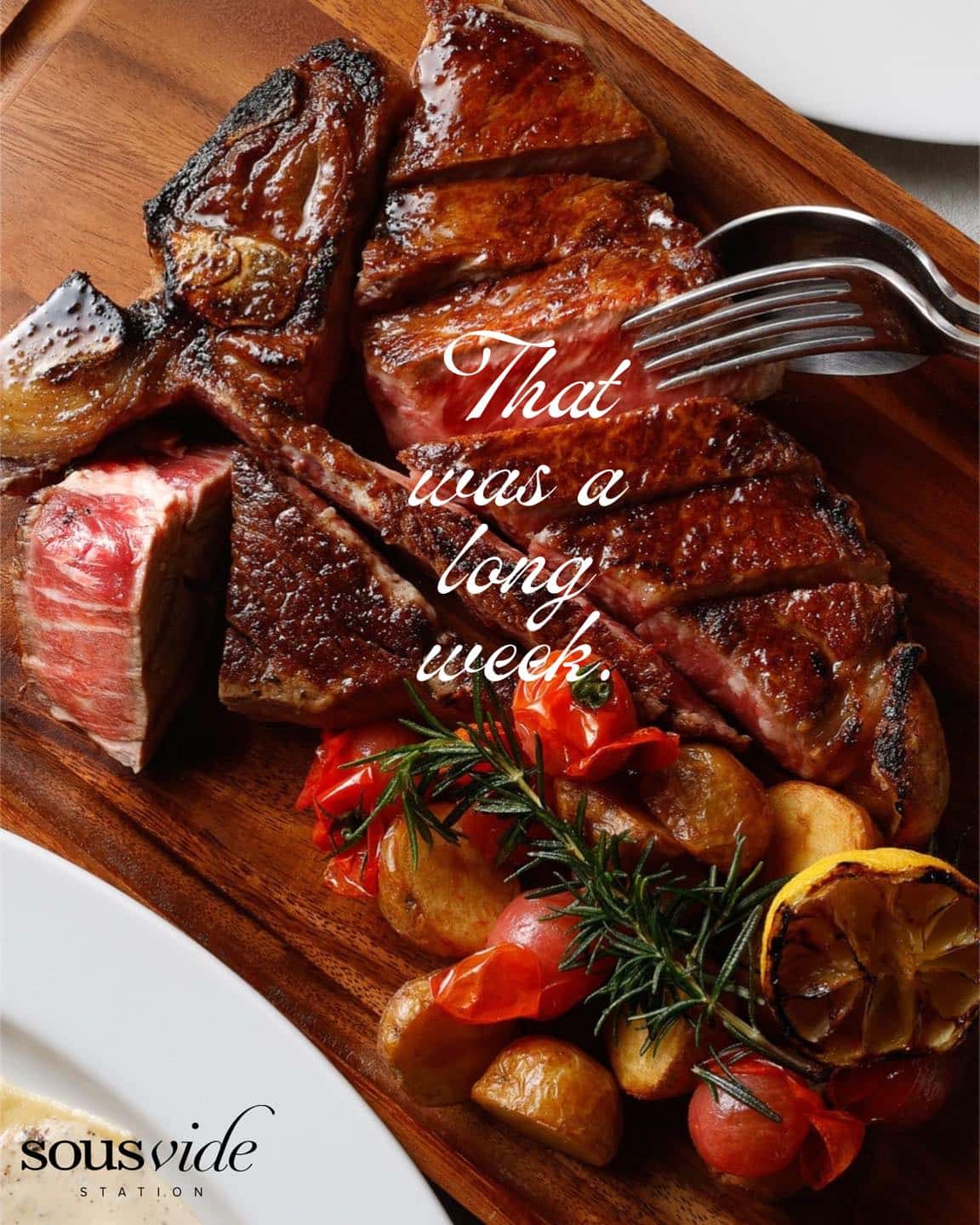
“Barbecue is the only sport where a fat, bald man is a god,” legendary pitmaster Johnny Trigg once declared. He was right – live-fire cooking is fueled by sweat, wood smoke, calloused hands, and a near-religious devotion to the craft.
Then came along a contraption straight out of a Swiss lab: an immersion circulator that warm-bathes meat in a plastic pouch.
The controversy was immediate. Modernists hailed sous vide steak as a breakthrough that eliminates human error forever. Traditional pitmasters watched a piece of raw ribeye drown silently in a water tank and wondered if we had officially lost our minds.
Can a water tank ever replace the soul, grit, and crackle of hardwood embers? Let’s take a deep dive into the technology, the technique, and the tension between high-tech precision and pure elemental smoke.
What is Sous Vide, Really?
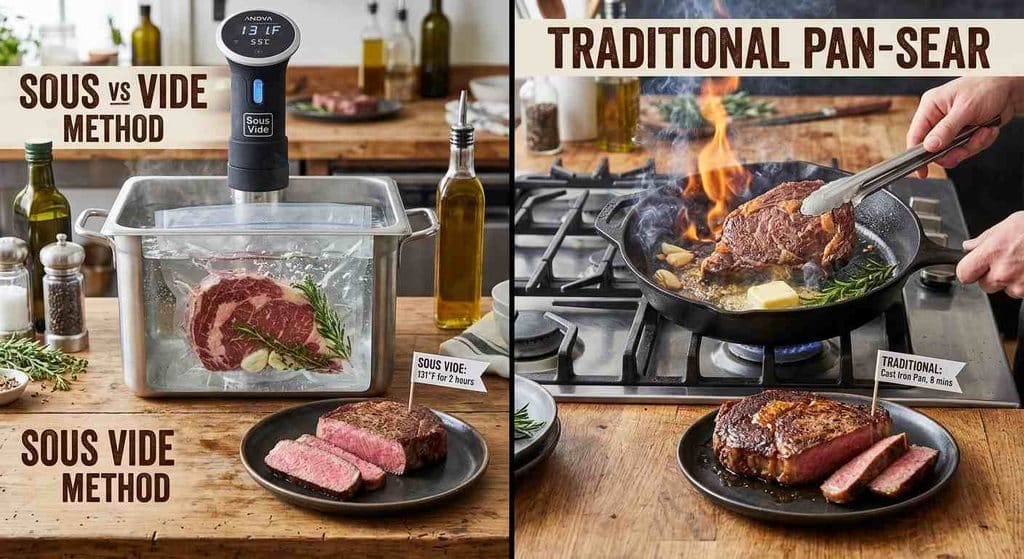
Stripping away the culinary jargon, sous vide translates directly from French to “under vacuum.” The process involves sealing a seasoned piece of meat in a plastic bag and submerging it into a temperature-controlled water bath.
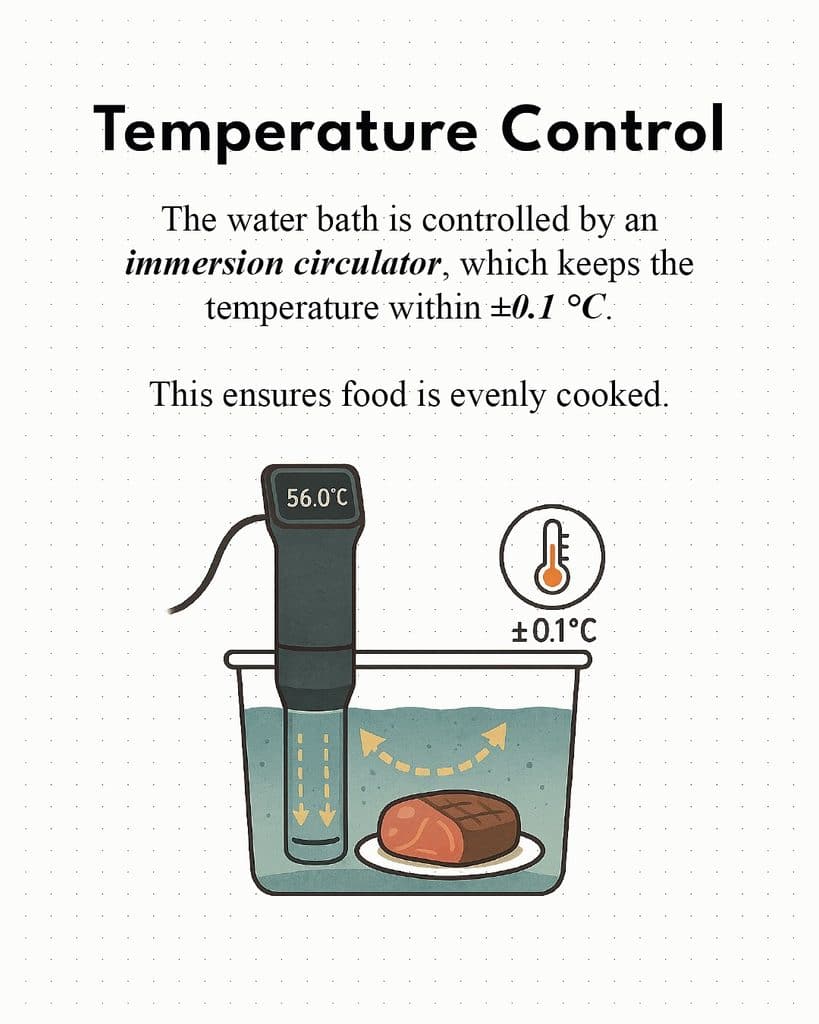
An immersion circulator heats the water to an exact, unyielding degree and keeps it moving continuously.
Here is how the basic workflow operates from start to finish:
- Prep & Seal: Seasoned raw steak is placed inside a food-safe plastic pouch, and all air is vacuumed out.
- Precision Bath: The sealed pouch drops into a water bath held at your exact target doneness (for example, 132°F for medium-rare).
- Finish & Sear: The fully cooked meat comes out of the bath and gets a blisteringly hot, high-heat flash sear on cast iron, over charcoal, or with a torch to build a crust.
Here is why that precision matters so much to modern home cooks and restaurant kitchens:
- Zero Thermal Gradient: Cooking a sous vide steak on a grill hits the exterior with 500°F (260°C) heat to bring the center to 132°F (55.5°C). That creates a gradient—a small target of medium-rare pink right in the middle, surrounded by a ring of overcooked, gray meat. A water bath set to 132°F heats the entire cut edge-to-edge to that exact temperature.
- The Infinite Safety Net: Leave a steak on a hot grill two minutes too long, and dinner becomes shoe leather. Leave a sous vide steak in a 130°F (54.4°C) water bath for an extra hour? It simply stays at 130°F. The structural proteins do not overheat, meaning the meat cannot overcook.
- A Complete Lack of Fire: No flames, no oxygen exchange, no wood, and zero smoke.
For engineers and busy home cooks, it represents pure genius. For anyone who spent their entire weekend tending an offset smoker, it feels like cheating with a heating rod.
The Case for “Pure Genius”
Dismissing this method entirely misses how remarkable the science really is. Precision water bath cooking solves several of the trickiest problems in whole-cut protein preparation.
1. Flawless Edge-to-Edge Doneness
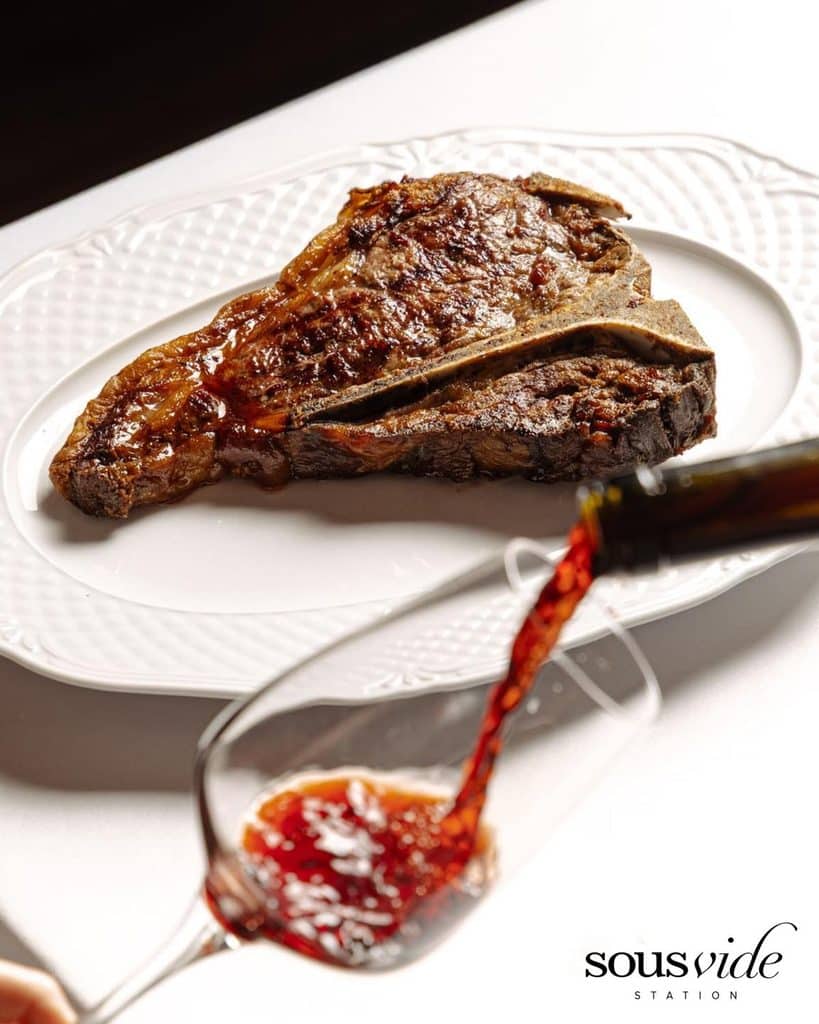
Nothing beats slicing into a thick-cut 2-inch bone-in ribeye and seeing a solid, uniform wall of rosy pink from the top surface to the bottom edge.
On a traditional high-heat grill surface, you get a gray overcooked outer ring, a band of medium-well brown, and only a tiny band of pink in the very center.
With a water bath, the entire interior stays pink while only a micro-thin outer crust gets seared at the end.
2. Texture Modification in Tough Cuts
Tenderness is governed by temperature and time. Collagen breaks down into gelatin over extended periods at warm temperatures.
Normally, cooking a tough cut like chuck roast or beef shank long enough to melt collagen means raising the temperature to 160°F–200°F (71°C–93°C), leaving you with pulled beef.
Sous vide breaks those rules.
By holding a tough chuck steak at 131°F (55°C) for 36 to 48 hours, collagen dissolves, yielding a steak with the tenderness of a prime tenderloin and the doneness of a medium-rare steak.
3. Trapped Aromatics and Moisture Loss
Meat shrinks and squeezes out moisture as its muscle fibers contract under heat. On an open grate, those juices fall onto the coals and evaporate.
Inside a sealed bag, juices cannot escape. Rendered fat, herbs, garlic, and butter stay locked in place, constantly bathing the meat in its own liquids during the cook cycle.
The Pitmaster’s Rebuttal: Why It Feels “Soulless”
Precision is great for manufacturing car parts, but live-fire cooking is an interactive art form. Taking fire out of the equation strips away what makes barbecue special.
No Smoke, No Bark
Real barbecue relies on combustion gases. Hardwood smoke carries volatile phenols and particulate matter that adhere to the moist surface of meat, producing that distinct, savory smoke ring and deep mahogany bark.
A vacuum-sealed plastic bag is an impenetrable barrier. You cannot infuse hickory, post oak, or mesquite smoke into a steak that is submerged underwater in a bag.
The Wet Meat Problem (The Maillard Nightmare)
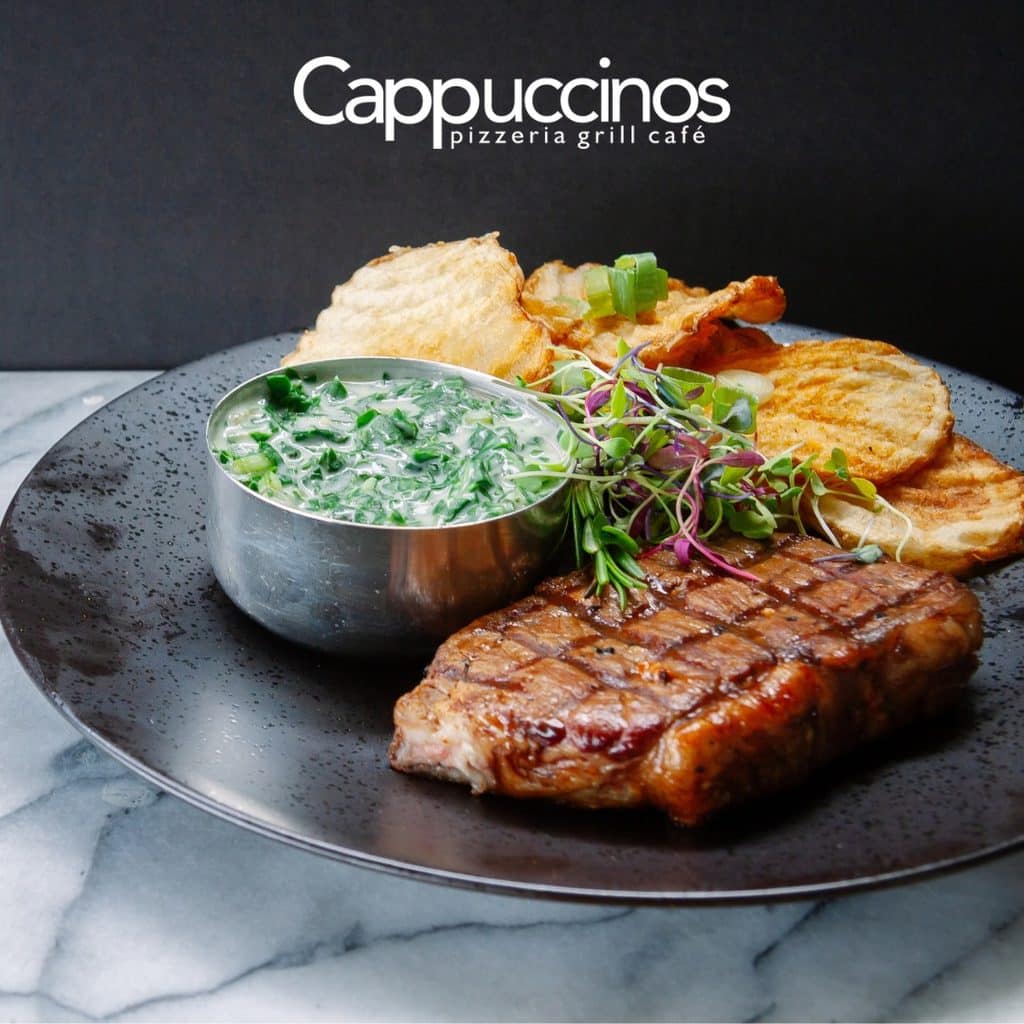
Water is the natural enemy of a good crust. High-heat searing triggers the Maillard reaction – the chemical reaction between amino acids and reducing sugars that turns the surface brown and gives steak its deep, nutty flavor.
- Moist Surface + High Heat = Steaming (No browning occurs, surface turns gray)
- Dry Surface + High Heat = Searing (Rich crust and Maillard browning occur)
Water boils at 212°F (100°C), while the Maillard reaction speeds up between 300°F and 400°F (150°C to 200°C).
When a sous vide steak comes out of its pouch, it is drenched in trapped rendered juices. Placing that wet steak directly into a blazing-hot cast-iron skillet causes the surface moisture to turn to steam immediately.
Instead of browning, the surface steams gray. By the time that moisture boils off to form a dark crust, the heat has penetrated deep into the steak, destroying the edge-to-edge medium-rare core you bought the device for in the first place.
To get around this, you must thoroughly pat the meat bone-dry with paper towels, let it air-dry in the fridge, or plunge the bag into an ice bath to chill the center before scorching the surface.
That is a lot of extra work for a method supposed to save time.
The Loss of Craft and Ritual
Fire management is a sensory ritual. You listen to the sizzle, watch the color of the smoke, feel the ambient humidity, and press the meat with a thumb to check its resistance.
Sous vide swaps that interactive process for a digital panel, a wall outlet, and a timer. It turns cooking into an automated process.
Comparative Breakdown: Precision vs. Element
Comparing high-tech immersion bath techniques directly with traditional live-fire grates reveals clear tradeoffs for both methods:
| Feature / Metric | Sous Vide + Post-Sear | Traditional Live-Fire / Smoking |
| Internal Gradient | Perfect edge-to-edge pink core | Bullseye gradient with gray outer band |
| Smoke Flavor Profile | Non-existent (unless artificially added) | Deep, authentic hardwood notes |
| Crust / Bark Formation | Micro-thin crust, highly prone to steaming | Thick, crunchy, mahogany bark |
| Error Tolerances | Multi-hour safety margin | Narrow window before meat overcooks |
| Juice Retention | High (juices remain sealed in bag) | Moderate (drippings burn off on coals) |
| Process Engagement | Set-it-and-forget-it automated step | Active fire-tending, touch, and feel |
The Hybrid Approach: Bridging Both Worlds
You don’t have to choose between strict culinary science and live fire. Combining both methods yields incredible results through an approach known as Smoke-Vide.
Follow this three-step hybrid process for the best of both worlds:
- Cold Smoke: Place raw, well-chilled steaks into an offset smoker running low with heavy hardwood smoke (under 110°F / 43°C) for 45 minutes. The cold surface absorbs smoky combustion compounds without cooking the interior.
- Precision Bath: Vacuum-seal the smoky, raw steak and run it through a standard sous vide steak water bath at 130°F (54.4°C) for two hours.
- High-Heat Sear: Remove, dry the surface thoroughly, and sear it over screaming-hot hardwood coals.
This gives you authentic wood-smoke flavor, edge-to-edge pink doneness, and a charred crust.
Pre-Searing Tough Pitmaster Cuts
For tough cuts like beef short ribs, sear the seasoned raw meat over glowing embers first to build a crust and smoke baseline. Vacuum-seal and drop it into a water bath for 24 to 72 hours, then re-flash it on the grill right before serving.
The Cold-Searing Hack: Flipping High-Heat Rules on Their Head
Most pitmasters drag out screaming-hot cast iron to sear a wet bag-steak, but modern food scientists are turning that logic backward with cold-searing.
Instead of scorching the exterior, you drop a chilled, dried sous vide steak into a cold non-stick skillet over medium-low heat with zero added fat.
- Slow Fat Rendering: As the pan gradually warms, the meat’s intramuscular fat renders directly into the skillet, coating the surface.
- Surface Dehydration: The low-heat exposure slowly dries out outer moisture, creating a shatteringly crisp crust without overcooking the pink center.
- Clean & Quiet: Starting with low heat eliminates smoke alarms, acrid burnt oil, and messy grease splatters.
It feels counterintuitive to live-fire veterans, but this low-temperature searing technique yields an astonishingly thin, glass-like crust.
The Chemical Illusion: Fake Smoke vs. Thermal Reaction
When water-bath enthusiasts try adding liquid smoke or smoked salt inside the vacuum bag, pitmasters shudder. Dumping bottled wood distillate into a bag creates a harsh, chemical afterthought rather than an authentic hardwood patina.
- Complex Combustion vs. Bottled Additives: Real smoke contains hundreds of organic compounds – like guaiacol and syringol – that bind dynamically with raw meat proteins under heat and oxygen.
- The Steam Trap: A water bath locks in moisture, turning subtle liquid smoke into a concentrated, artificial brine.
- Lack of Airflow: True smoke flavor requires time and airflow as volatile gases bind to a drying surface.
For live-fire purists, pretending a chemical drip replaces the interaction of glowing oak embers is the ultimate sin against real barbecue.
Microbe Safety & The Danger of the Warm-Water Danger Zone
Cooking meat at ultra-low temperatures brings serious biological risks if you don’t respect food safety parameters. The USDA warns that the bacterial danger zone sits between 40°F and 140°F (4°C to 60°C), where pathogens like Clostridium perfringens thrive.
- Anaerobic Breeding Grounds: Holding a sous vide steak below 130°F (54.4°C) for longer than two hours creates an ideal environment for harmful bacteria inside an oxygen-deprived bag.
- Fire vs. Water: Pitmasters rely on direct heat, radiation, and dry air to naturally sterilize meat surfaces quickly.
- Thermal Math: Water-bath cooks must rely strictly on precise timing to achieve log-reduction pasteurization without cultivating dangerous toxins.
Equipment Creep: From Simple Tongs to Lab-Grade Gear
Barbecue grew out of simplicity: a metal grate, a bag of charcoal, a pair of tongs, and a sharp knife. Entering the immersion circulator world triggers an expensive cascade of culinary equipment creep.
- The Starter Setup: A simple stick circulator and a basic kitchen pot.
- The Lab Expansion: Dedicated vacuum sealers, chamber pouches, insulated water tubs, weighted rack sinkers, and industrial blowtorches.
Suddenly, your backyard sanctuary looks less like a rust-rimmed pit and more like a biomedical research lab.
While live-fire cooking rewards human intuition and sensory feel, precision cooking demands hardware upgrades and digital calibration.
It forces every cook to decide whether to master an ancient elemental craft or manage a stack of high-tech appliances.
The Acid & Enzyme Trap: Over-Tenderizing Meat into Mush
Adding marinades, citrus, or fresh pineapple to a traditional grill setup brightens flavors and tenderizes the outer layers. Drop those same acidic ingredients or proteolytic enzymes inside a vacuum pouch, and catastrophe strikes.
- Continuous Enzyme Activity: Sealed inside an immersion bath, active enzymes work continuously at warm temperatures without evaporating off.
- Loss of Texture: Prolonged exposure breaks down muscle tissue so completely that a premium sirloin turns into an unappealing, mealy paste.
- Grill vs. Bag Dynamics: Live-fire grilling burns off excess surface liquids while searing the outer flesh to preserve structural integrity.
In a closed water system, time and acid act like a slow-motion blender, proving that excessive chemical tenderization easily ruins prime cuts of beef.
Environmental Impact: Plastic Waste vs. Carbon Footprint
Beyond flavor and technique lies an unavoidable modern debate: the environmental trade-off between single-use plastics and wood combustion.
- Synthetic Waste: Every immersion bath run consumes heavy-duty polyethylene vacuum bags that end up directly in landfills after a single meal.
- Atmospheric Emissions: Traditional offset smokers burn natural hardwoods or charcoal, releasing carbon emissions and particulate smoke into the local air.
Choosing your cooking method isn’t just about taste or edge-to-edge pink doneness anymore – it forces cooks to weigh their reliance on disposable petroleum products against the atmospheric footprint of an open wood fire.
Why the Reverse Sear Still Rivals Sous Vide
Many backyard pitmasters prefer the low-and-slow reverse sear over water baths. By placing raw steak on a smoker at 225°F (107°C) until its core hits 115°F (46°C), you slowly dry out the outer surface while absorbing smoke.
When you move that bone-dry, smoked steak to a hot hardwood grate, the Maillard reaction happens instantly. You get deep wood flavor and a heavy crust without steam getting in the way.
Verdict: Tool vs. Culture
Is cooking a sous vide steak pure genius or soulless?
It isn’t a crime, and it isn’t a cheat code. It is simply a tool – a laboratory instrument designed for consistency, temperature control, and convenience.
When catering for fifty people and needing every plate brought to an identical medium-rare, an immersion circulator is pure genius.
It saves time, lowers stress, and guarantees quality control.
However, barbecue has never been solely about efficiency. It is built around fire management, patience, wood selection, and years of hands-on practice.
If you want absolute predictable accuracy, buy an immersion circulator. If you want the thrill of controlling live fire, deep smoke rings, and real flavor development, build a fire, grab your tongs, and keep your eyes on the coals.
Frequently Asked Questions
Is sous vide steak safe to cook in plastic bags?
Yes, provided you use food-safe bags rated for cooking temperatures.
Look for bags that are explicitly labeled BPA-free and phthalate-free, made from high-density polyethylene (HDPE) or polypropylene (PP).
Avoid standard zip-top bags not rated for heat, as they can break down or leak.
What is the best cut of steak for sous vide?
Thick-cut, lean-to-moderately fatty cuts like Filet Mignon, Strip Steak (New York Strip), and Top Sirloin excel in a water bath.
Extremely thick cuts (2 inches or more) benefit the most because traditional sear methods often burn the outside before the center cooks through.
Why does sous vide fat sometimes feel rubbery?
Beef intramuscular fat (like the fat cap on a Ribeye) renders best at temperatures between 130°F and 140°F (54°C to 60°C).
If you cook a thick Ribeye at a rare doneness of 122°F (50°C), the fat will not reach a high enough temperature to soften and render, leaving it tough and chewy.
For high-fat cuts, cook at 133°F–135°F (56°C–57°C) to ensure the fat breaks down properly.
Can you cook a steak in sous vide straight from the freezer?
Yes. You can vacuum-seal seasoned raw steaks and freeze them. When you are ready to cook, drop the frozen pouch directly into the water bath.
Simply add an extra 45 to 60 minutes to the total cook time to allow the core to thaw and reach target temperature safely.
Featured image credit: @sousvidestation
