
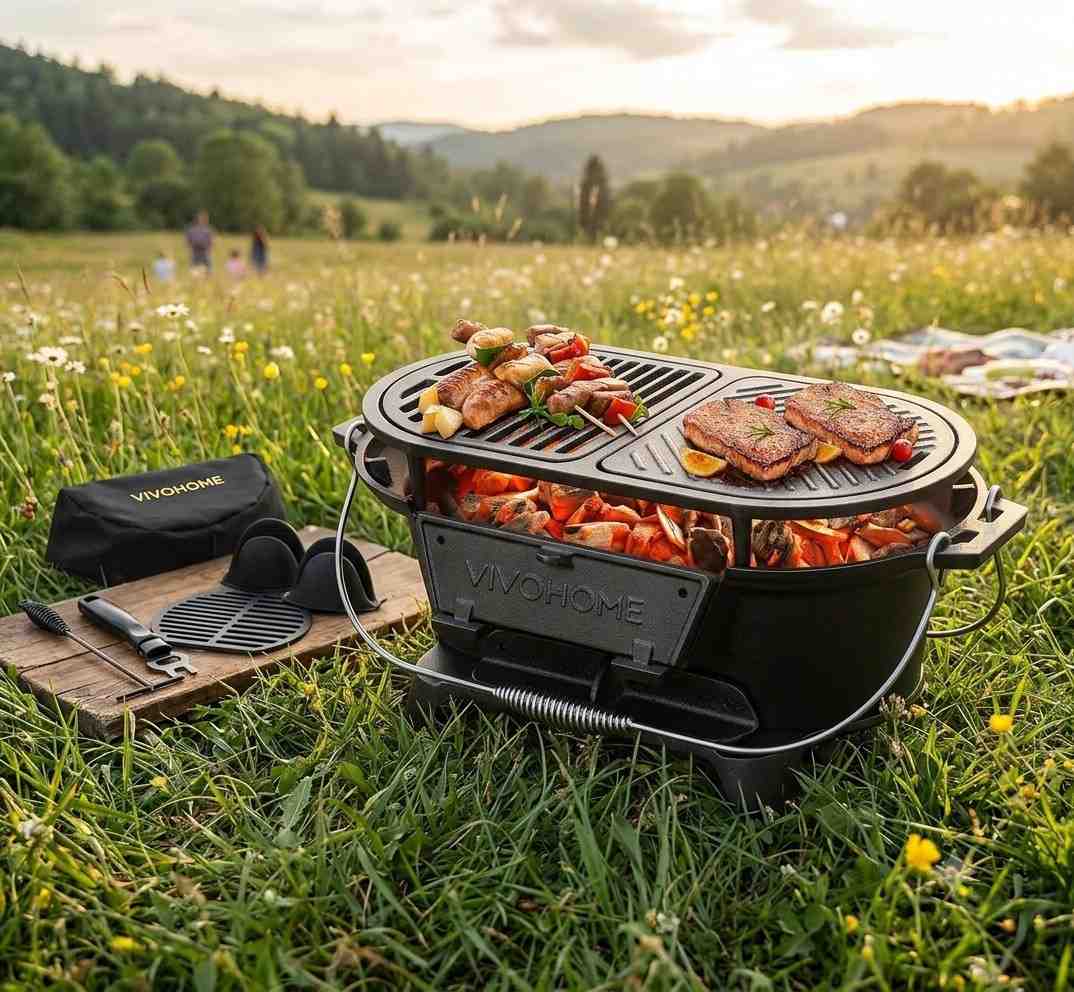
The High-Stakes Holiday Cookout
Independence Day demands fire, smoke, and an ungodly amount of protein.
The backyard becomes a battlefield of intense heat, short tempers, and hungry guests tracking mud across the porch. When the calendar hits July, expectations soar, making the choice of backyard machinery an absolute make-or-break decision.
Most people assume that pulling off legendary racks of ribs or deeply seared burgers requires a multi-thousand-dollar ceramic egg or a heavy-gauge offset smoker delivered on a wooden pallet. That assumption changed completely during this round of testing.
A dark horse entered the smoke rings this summer. The VIVOHOME Charcoal Grill arrived with modest branding but heavy ambitions, instantly setting off alarms of skepticism.
A brand widely recognized for household electronics and indoor appliances suddenly throwing its apron into the high-stakes world of live-fire cooking felt like a massive gamble.
Yet, after putting this machine through three days of rigorous temperature spikes and continuous grease drippings, it turned out to be the most surprising standout performer of the season.
The Quick Verdict: The VIVOHOME Charcoal Grill punches clean out of its weight class. It combines smart airflow control with a highly responsive mechanical coal tray, offering budget-conscious cooks an incredibly reliable, feature-rich backyard workhorse that handles holiday crowds without breaking a sweat.
Unboxing and Assembly: Iron, Ink, and Elbow Grease
Delivery day brought a heavy, rectangular box weighing roughly 60 pounds, wrapped tight enough to survive an international voyage. Every piece of steel inside was individually shielded with dense foam blocks, preventing the dreaded metal-on-metal chipping that plagues cheap flat-pack cookers.
Peeling back the plastic revealed a matte-black powder-coated finish that immediately looked more “heavy metal festival” and less “hardware store clearance rack.” The visual weight of the parts promised a stable footprint once fully bolted together.
Putting the unit together required a solid hour and a half, a cold beverage, and a decent ratcheting wrench to replace the flimsy mini-tools included in the package.
The assembly blueprint relied on clear diagrams rather than poorly translated paragraphs, ensuring that the legs, frame braces, and firebox aligned perfectly without needing to force any cross-threaded bolts.
A minor issue popped up with the front charcoal door hinge, which required a bit of manual alignment to seal perfectly tight against the main frame, but the overall structure locked down solid, lacking any wobble or structural flexing when rolled across uneven grass.
Technical Specifications and Hardware Architecture
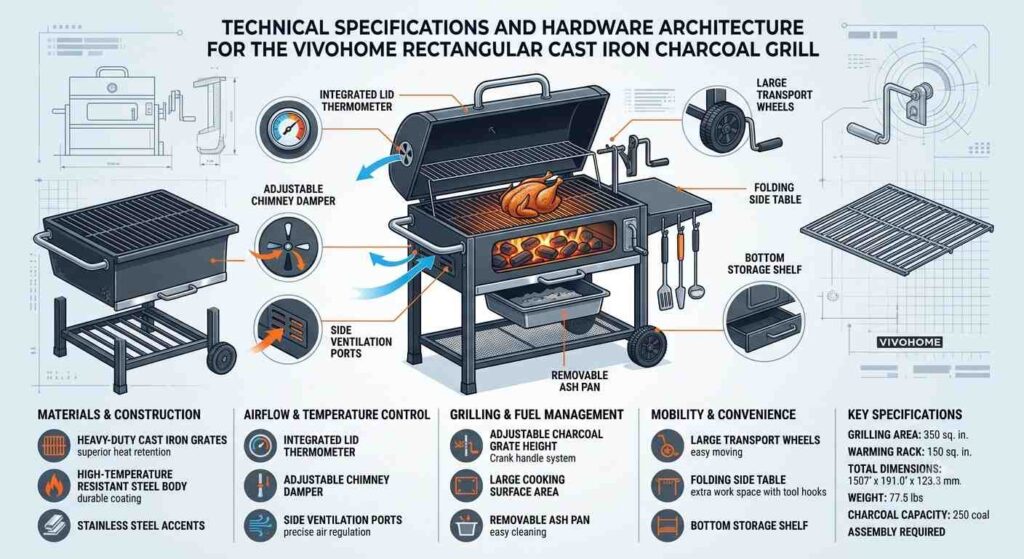
Evaluating this machine requires looking past marketing jargon and analyzing the raw engineering numbers. The cooking layout presents a dual-tier arrangement that maximizes usable area without creating awkward dead zones where food gets trapped away from the heat source.
| Specification Feature | Measurement Detail | Practical Capacity Reference |
| Primary Grate Surface Area | 380 Square Inches | Holds roughly 20 standard-size burger patties |
| Secondary Warming Rack Area | 200 Square Inches | Perfect for 12 hot dog buns or keeping corn warm |
| Total Combined Grilling Space | 580 Square Inches | Feeds a backyard party of 8 to 12 adults smoothly |
| Grate Construction Material | Porcelain-Coated Cast Iron | Heavy thermal mass for excellent heat retention |
| Assembled Machine Weight | Approximately 57.3 lbs | Sturdy enough against wind, mobile on wheels |
The core structural highlight is the mechanical crank system controlling the adjustable charcoal pan. Instead of reaching inside with heavy heat-resistant gloves to shift burning coals, a heavy-duty front lever raises or lowers the entire fire bed smoothly.
This lets you change thermal intensity on the fly. Air flow is regulated through two sliding side dampers paired with a top-mounted smoke stack, allowing precise management of oxygen intake.
A dedicated front access door lets you toss in extra hickory chunks mid-cook, while two sturdy side shelves feature integrated tool hooks, ensuring your tongs, brushes, and sauce mops remain within arm’s reach.
The Independence Day Litmus Test: Performance Review
Temperature Control and Airflow Dynamics
Lighting a full chimney stack of hardwood lump charcoal showed how fast the firebox responds to ambient oxygen. With all dampers wide open, the internal temperature shot past 400°F within twelve minutes.
The built-in lid thermometer reacted quickly to internal changes, though matching it against dual digital ambient probes revealed a consistent variance: the lid thermometer ran roughly 15°F hotter than the actual cooking surface due to heat rising into the dome.
Adjusting the side dampers immediately affected the fire; choking down the left intake caused a direct drop in thermal output within two minutes, proving that the firebox seals well enough to manage airflow reliably.
High-Heat Searing Performance
To test high-heat capabilities, the charcoal pan was cranked to its highest position, bringing the white-hot coals within three inches of the main grates. The porcelain-coated cast iron grates absorbed the intense energy beautifully, maintaining heavy thermal mass without warping under extreme stress.
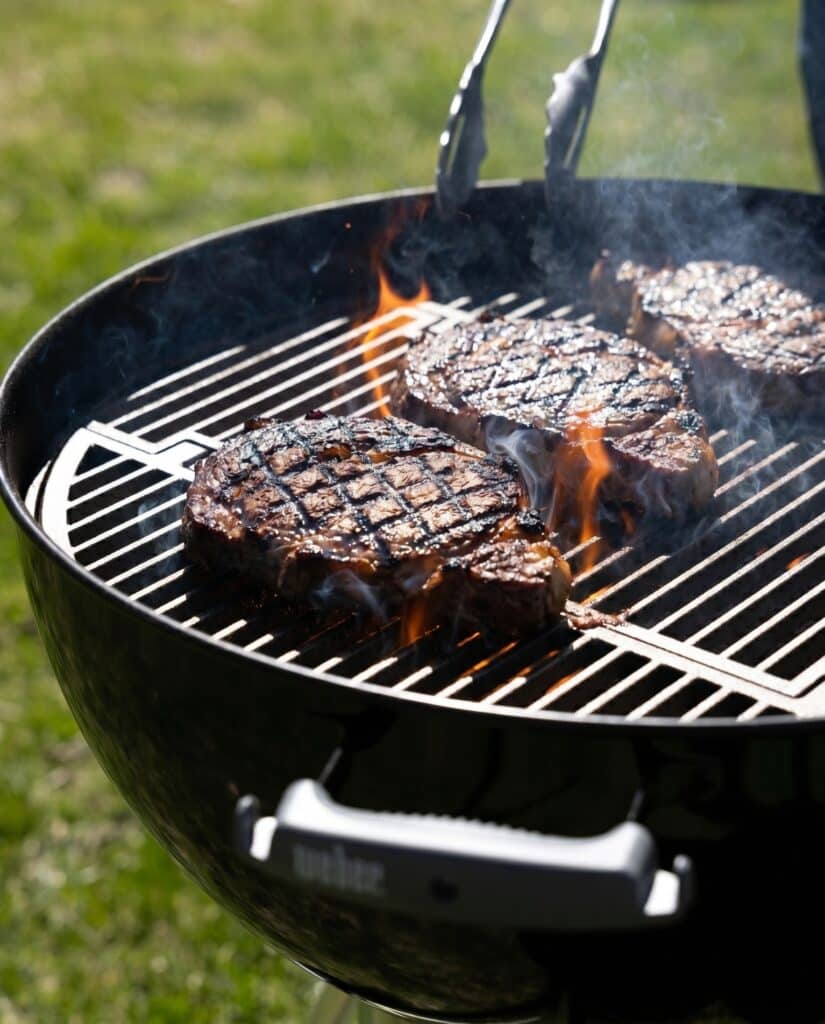
Dropping half a dozen thick ribeyes onto the surface produced an immediate, satisfying hiss. The grates delivered deep, dark crosshatched sear marks while locking in juices, validating the grill’s ability to operate as a high-heat steak machine for fast holiday cooking.
Pro-Tip for Maximum Sear: Keep the lid closed for the first 90 seconds after dropping your steaks.
The radiant heat bouncing off the inner lid dome cooks the top of the meat simultaneously, ensuring an even crust formation once you flip.
Low-and-Slow Smoking Performance
Shifting from high-heat searing to low-and-slow smoking requires distinct structural discipline.
By arranging a snake pattern of charcoal briquettes mixed with applewood chunks and lowering the coal pan to its floor setting, the VIVOHOME Charcoal Grill settled into a steady cruising altitude of 235°F.
It held this temperature zone for four hours without requiring constant adjustment.
The front access door proved its worth here: opening it to slide in three more wood chunks caused virtually no drop in ambient dome temperature, because the main lid remained completely shut, keeping the delicate smoke convective loop intact.
Real-World Crowd Capacity
Feeding a full backyard crowd means dealing with massive volume all at once. During our maximum capacity trial, the primary grates easily held sixteen large hand-pressed burgers along with four thick smoked sausages without feeling cramped.
The warming rack served as an excellent thermal buffer zone, holding toasted brioche buns and grilled corn away from direct flames while the next batch of meat finished searing below.
This dual-zone arrangement prevents the common backyard disaster of serving charred exterior meat with cold interiors.
The Cons: Where the VIVOHOME Cuts Corners
No piece of budget hardware is flawless, and this review wouldn’t be honest without highlighting where production costs were cut. The main structural steel sheets are thinner than the heavy-gauge metal found on legacy cookers that cost three times as much.
While it retains internal heat perfectly well on a balmy July afternoon, cooking in late autumn or during a brisk spring wind will require extra fuel to compensate for thermal loss through the thin metal walls.
The secondary flaw lies in the factory seals around the lid rim and the front charcoal door.
Tiny wisps of smoke escaped from the upper corners during our smoking tests, showing minor air leaks. While this doesn’t ruin your ability to smoke food, it does let a small amount of heat escape.
For backyard perfectionists, fixing this is simple: spending ten dollars on a roll of self-adhesive, high-temperature fiberglass felt tape completely seals the edges, instantly turning the machine into a rock-solid, airtight smoker lockbox.
Value Proposition and Market Comparison
Looking at the broader market, charcoal cookers generally fall into two camps: oversimplified entry-level kettles that offer zero workspace, or industrial-grade steel pits that require a massive budget and a dedicated concrete pad.
The VIVOHOME Charcoal Grill carves out a highly competitive space directly in the middle. It gives you the expansive surface layout and convenient side shelves of a premium barrel grill while keeping the price accessible for casual weekend cooks.
When stacked directly against classic 22-inch kettle designs, this machine wins hands down on sheer versatility and ergonomics.
You no longer have to balance a hot, greasy lid on a tiny metal hook or struggle to arrange two distinct heat zones inside a cramped circular bowl.
The rectangular shape provides a much cleaner separation for indirect cooking, making it an incredibly smart choice for anyone looking to upgrade their backyard cooking game without overspending.
Maintenance, Clean-Up, and Longevity
Post-party cleanup is usually the worst part of hosting, but the maintenance loop here is surprisingly painless. The entire bottom floor of the firebox features a full-width, removable ash drawer equipped with a sturdy front handle.
Once the coals are completely dead, sliding the tray out lets you dump the debris cleanly into a trash bin without scattering gray dust all over your patio.
The porcelain coating on the main cast-iron grates stops burnt meat fibers from sticking, meaning a quick pass with a stiff wooden scraper while the bars are warm cleans them completely.
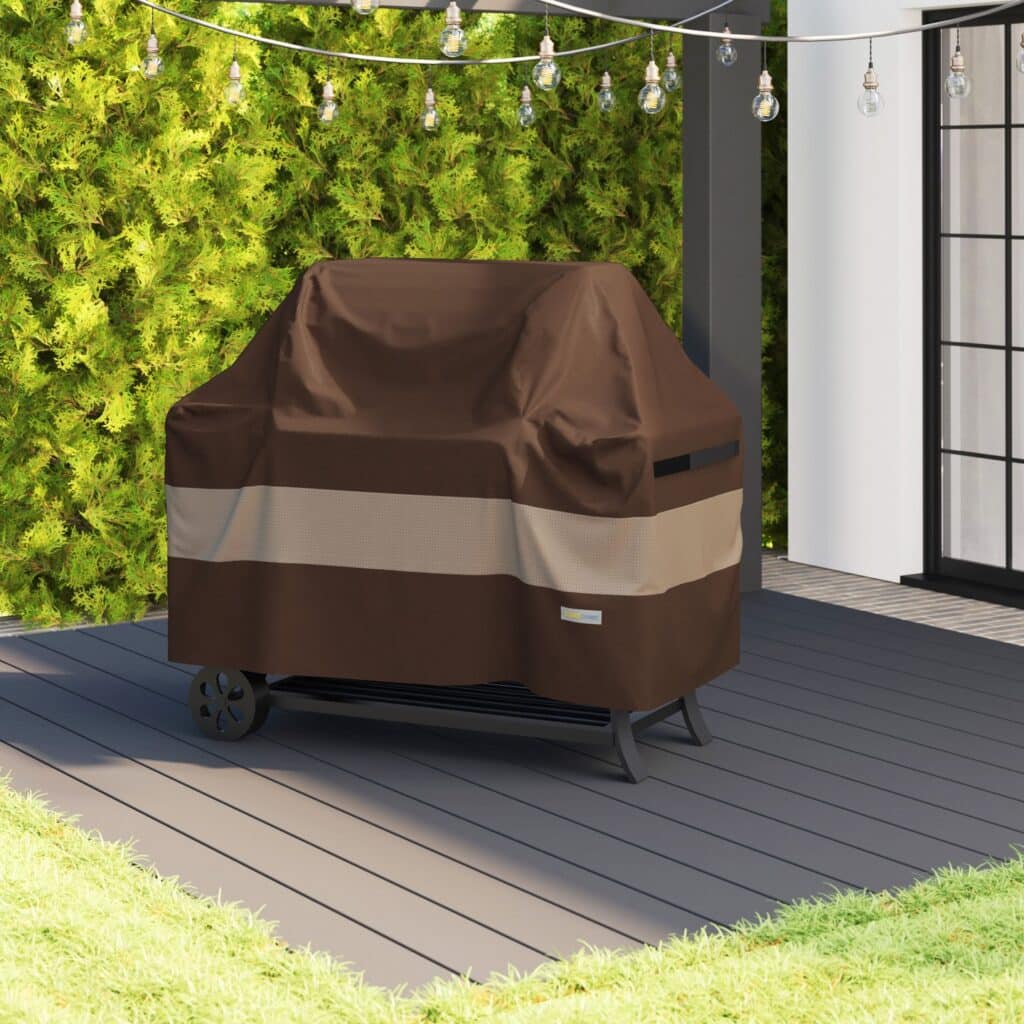
To ensure the steel body survives multiple seasons without rust setting in, investing in a heavy-duty, UV-resistant waterproof cover is mandatory. Thin powder coating will eventually succumb to moisture and morning dew if left exposed to the elements.
Keeping the interior seasoned with a light wipe of high-smoke-point canola oil after every clean protects the metal surfaces, keeping them primed for action year after year.
The Metallurgy of Flavor: Breaking Down Thermal Retention
While capacity matters, the underlying metallurgy of your firebox dictates how efficiently your fuel behaves.
This grill relies on lightweight, cold-rolled alloy steel sheets rather than industrial-grade, heavy-gauge plate metal. In plain terms, this architectural build directly impacts your cooking style:
- Lightning-Fast Preheating: The thinner body absorbs and transfers energy rapidly, creating incredibly quick startup times on warm afternoons.
- High Thermal Conductivity: Because the metal is thin, it demands extra structural vigilance, as the walls lose radiant energy instantly when hit by sudden wind gusts.
- Mitigation Strategy: To prevent radical internal temperature drops during a critical cook, position the machine shield-side to the wind and utilize premium, high-density hardwood lump charcoal to counteract its natural limitations.
Modding the Machine: Three Cheap Upgrades for Pitmaster Performance
A true backyard pitmaster treats a factory-spec grill as a blank canvas. To elevate this budget workhorse into a professional-tier cooker, you need to implement a few aftermarket modifications (mods) that maximize your airflow efficiency:
- Seal the Gaps: Install high-temperature fiberglass gasket tape along the lid perimeter to eliminate perimeter smoke bleed and lock in heat.
- Upgrade the Readout: Replace the stock lid thermometer with a calibrated, dual-probe digital transmitter to read true, precise grate-level heat.
- Shield the Base: Line the bottom of the ash drawer with heavy-duty aluminum foil to simplify grease cleanup and prevent corrosive buildup.
These minor, inexpensive adjustments instantly turn a standard hardware setup into a sealed, airtight smoking chamber that rivals competitive rigs three times its price.
The Science of Smoke: Mastering Wood Profiles for Charcoal Cooking
Arranging your charcoal bed is only half the battle; mastering the convective smoke loop requires a deep understanding of wood chemistry.
Because this grill features a dedicated front access door, you can easily introduce distinct flavor profiles without lifting the main lid and ruining your ambient environment:
- Hickory & Mesquite Chunks: Best for heavy proteins like beef brisket or short ribs; they release robust, sharp compounds that pierce through thick fat caps.
- Apple & Cherry Woods: Best for delicate poultry or pork loins; they offer a milder, sweet finish and impart a deep mahogany hue to the meat’s exterior crust.
Balancing your wood-to-coal ratio prevents bitter creosote buildup, ensuring clean, blue smoke flows continuously.
Choosing your ignition source is a critical decision that dictates your entire thermal strategy. On this responsive mechanical coal tray, understanding your fuel types allows you to build a superior firebox environment:
- Traditional Charcoal Briquettes: Engineered for mechanical uniformity and crafted with binding agents to deliver a predictable, slow-burning, and flat heat curve – making them the absolute gold standard for low-and-slow smoking.
- Hardwood Lump Charcoal: Consists of raw, charred natural timber that ignites rapidly, burns incredibly hot, and leaves minimal ash residue, though it lacks uniform sizing.
The Pitmaster Hybrid Setup: Layering a foundation of slow-burning briquettes beneath a top layer of high-heat lump charcoal gives you the ultimate combination of sustained longevity and intense searing power.
Weatherproofing Your Investment: Combating Rust and Seasoning Metal
An outdoor cooker’s greatest enemy isn’t a high-volume holiday crowd; it is atmospheric moisture.
Because budget-conscious manufacturing leaves a thinner layer of external powder coating, leaving this machine exposed to morning dew or heavy rain will trigger oxidative rusting along the weld lines.
To ensure multi-season longevity, you must execute a strict maintenance routine:
- Season the Interior: Treat the steel exactly like a cast-iron skillet by periodically coating the inner firebox and coal tray with a thin layer of high-smoke-point canola oil.
- Polymerize the Metal: Run a brief, clean heat cycle right after oiling to bake the glaze directly into the steel, creating a slick, water-resistant barrier.
- Shield the Exterior: Invest in a heavy-duty, UV-resistant waterproof cover to keep rain and humidity away from the exterior finish.
Best 3 Alternatives for the VIVOHOME Charcoal Grill
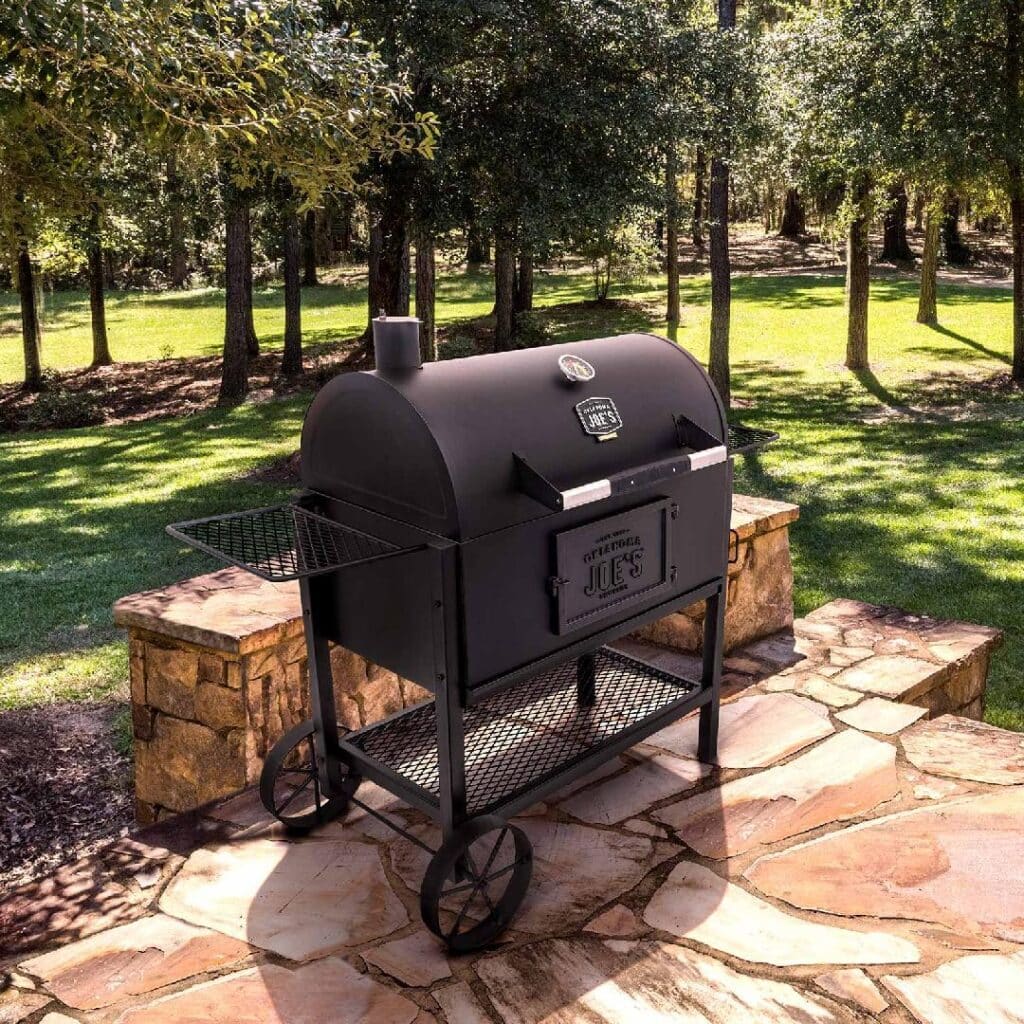
1. The Heavy-Duty Upgrade: Oklahoma Joe’s Judge Charcoal Grill
The Oklahoma Joe’s Judge replaces thinner budget steel with thick, heavy-gauge structural construction. It offers 540 square inches of primary cooking space on heavy cast-iron grates and features an adjustable charcoal tray alongside a glow-in-the-dark thermometer for reliable nighttime visibility.
Key Features & Unique Properties
- Extreme Heat Control: The height-adjustable charcoal tray lets you raise the coals right up to the grates for high-heat searing, or lower them to cook low-and-slow.
- Precise Airflow: Outfitted with large, heavy-duty air dampers that allow for incredibly accurate temperature management and draft control.
- Easy-Access Firebox Door: Features a front-facing door that lets you stoke the fire, rearrange coals, or add wood chunks mid-cook without opening the main lid and losing valuable heat.
- Hassle-Free Clean-up: Includes a full-size, slide-out removable ash pan that catches loose debris, solving one of the biggest headaches of traditional barrel charcoal grills.
- Cool-Touch Handle: Features a thick rubber grip on the lid handle that remains cool to the touch even when the firebox is roaring.
- Wagon-Style Mobility: Despite its heavy 215-pound build, the grill remains easy to maneuver around the patio thanks to its large, rugged wagon-style wheels.
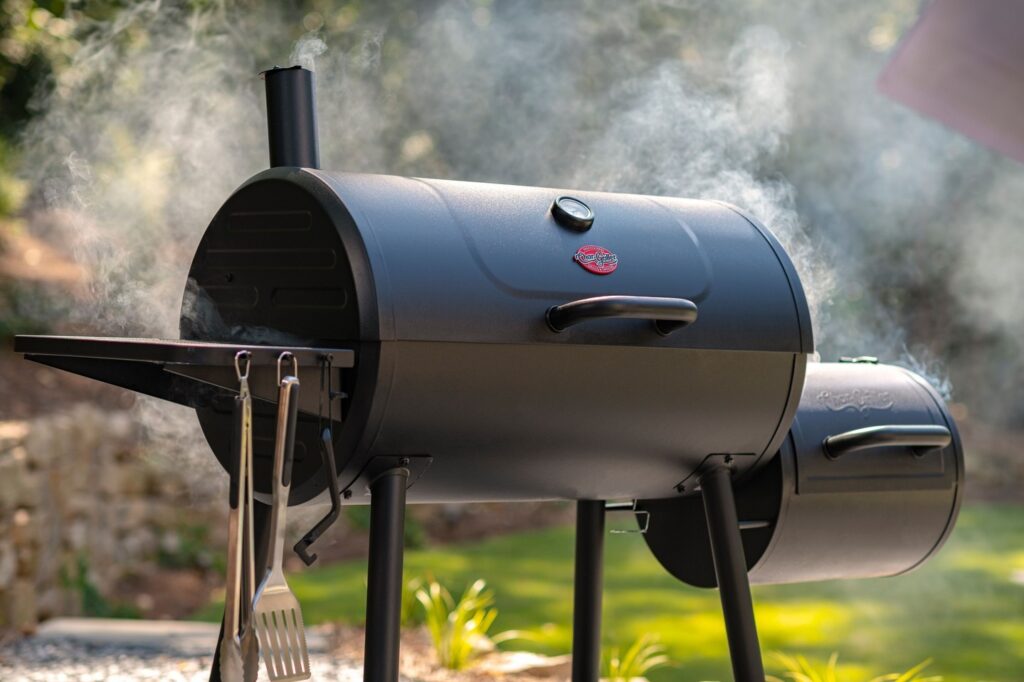
2. The High-Volume Workhorse: Char-Griller Pro Deluxe
The Char-Griller Pro Deluxe expands your crowd capacity to a massive 850 square inches of total cooking area.
It features premium front and side shelves with built-in utensil hooks, an EasyDump ash pan for clean maintenance, and seamless compatibility to add an offset side firebox later.
Key Features & Unique Properties
- Modular Side Firebox Compatibility: One of its most valuable properties is upgradeability. You can easily bolt on a Char-Griller Side Firebox (sold separately) to turn this classic barrel grill into a true horizontal offset smoker for low-and-slow Texas-style BBQ.
- Adjustable Fire Grate: Features an adjustable coal tray with multiple height settings. You can raise it up to sear steaks over intense direct heat, or lower it down to bake or roast with indirect heat.
- Cast-Iron Cooking Grates: Outfitted with heavy-duty cast-iron grates split into individual, easy-to-lift sections. They hold heat exceptionally well, provide classic steakhouse sear marks, and resist warping over time.
- Mess-Free EasyDump Ash Pan: Instead of scooping out hot soot, the patented EasyDump ash pan unlatches smoothly from the bottom of the grill, allowing you to empty the ashes in seconds without a mess.
- Heavy-Duty Steel Construction: Made from durable tubular steel with a double-bottom bowl designed to insulate heat and prevent the bottom of the grill from burning out.
- Storage & Utility: Includes a sturdy wire bottom shelf for holding extra bags of charcoal, a folding front condiment shelf, and integrated tool hooks on the side shelf to keep your spatulas and tongs within arm’s reach.
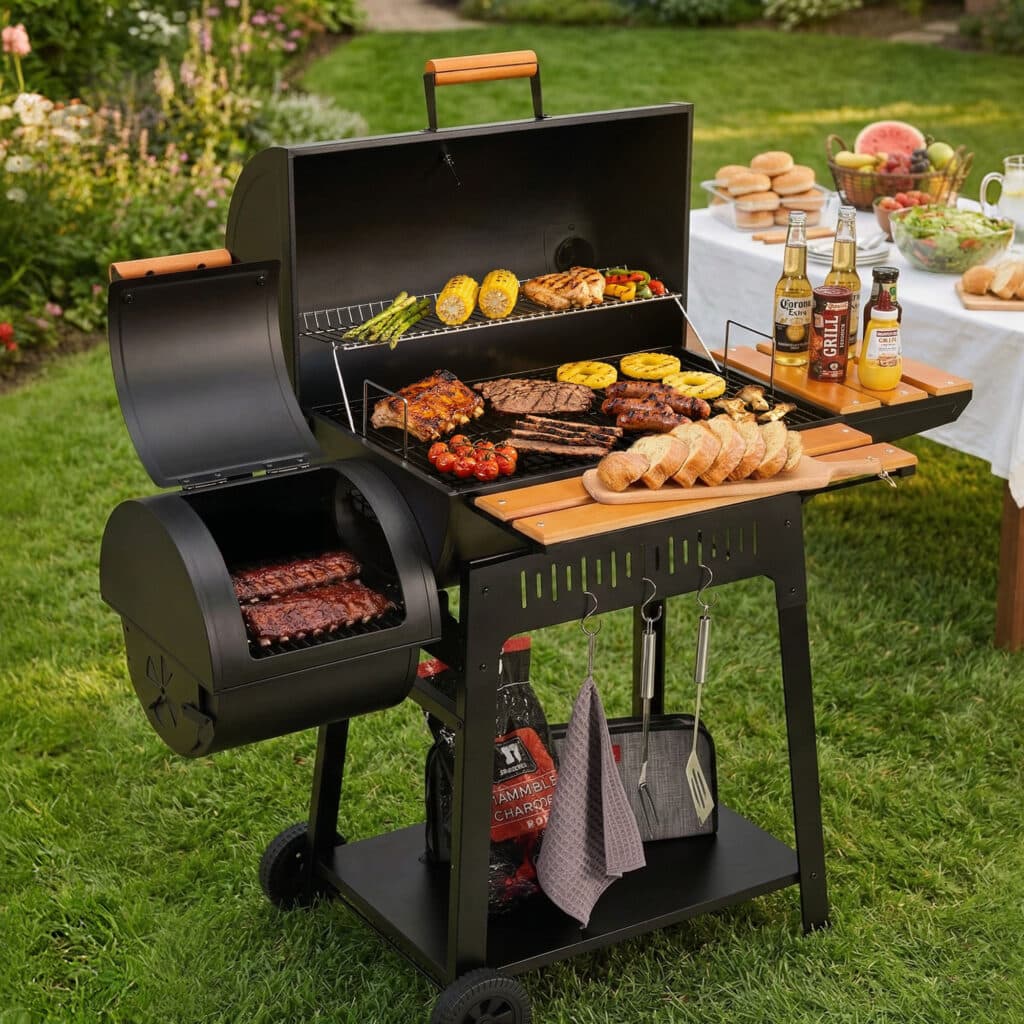
3. The Versatile Classic: Royal Gourmet CC1830V Barrel Grill
The Royal Gourmet CC1830V offers a competitive layout with 626 square inches of cooking area paired with traditional wood-painted front and side tables. It utilizes a multi-level adjustable charcoal pan for dual-zone heat control and is a highly cost-effective pick for casual weekend entertainers.
Key Features & Unique Properties
- Multi-Level Charcoal Pan: The adjustable steel charcoal pan features an easy-to-use lever mechanism with multiple height levels, giving you instant control over the cooking temperature by letting you physically raise or lower the heat source.
- Porcelain-Enameled Cooking Grates: The primary cooking grates are coated in durable porcelain enamel. This food-grade finish prevents rust, makes cleanup a breeze, and ensures food releases smoothly without tearing.
- Aesthetic & Functional Prep Space: The eye-catching wood-painted steel front and side tables offer ample room to hold spices, plates, and accessories, while the side table is equipped with integrated “S” hooks to keep your grilling tools organized.
- Superior Draft & Smoke Management: Features a built-in smokestack and adjustable side air dampers to maximize heat and smoke circulation, giving you excellent temperature stability across the barrel.
- Integrated Warming Rack: The chrome-plated warming rack provides 183 square inches of secondary space, perfect for keeping finished food hot or gently toasting hamburger buns.
- Sturdy & Mobile Cart: Built on a stable frame featuring a large bottom mesh shelf for charcoal bag storage, supported by two durable wheels for easy transport across your backyard or patio.
Final Verdict and Scorecard
Ultimately, the VIVOHOME Charcoal Grill proves that you don’t need to drop a mortgage payment to rule the neighborhood block party. It isn’t a flawless, heirloom-grade steel pit, but it never claims to be.
Instead, it’s a brilliant, budget-friendly underdog that delivers exactly where it counts: massive capacity, smart airflow design, and the invaluable flexibility of a mechanical coal tray.
For the casual weekend griller or the designated holiday chef looking to survive the high-stakes chaos of the summer cookout without breaking the bank, this machine is an undeniable victory.
If you’re ready to graduate from cramped kettle cookers and command your backyard with confidence, this dark horse has earned its spot on your patio.
Backyard Performance Evaluation
- Assembly Clarity: ★★★★☆ (4/5)
- Heat Responsiveness: ★★★★★ (5/5)
- Build Durability: ★★★☆☆ (3.5/5)
- Overall Value Metric: ★★★★★ (5/5)
Frequently Asked Questions
Q: How many burgers can the VIVOHOME Charcoal Grill hold at once?
A: The primary grate features 380 square inches of cooking surface, which comfortably holds roughly 16 to 20 standard-size burger patties simultaneously. An additional 200-square-inch warming rack keeps buns and sides warm.
Q: Is the built-in lid thermometer accurate?
A: It reacts quickly to temperature shifts but runs consistently 15°F hotter than the actual cooking surface because heat rises and collects in the top dome. For precise low-and-slow smoking, using a digital grate-level probe is highly recommended.
Q: How do you adjust the heat intensity without opening the lid?
A: The grill uses a heavy-duty front crank lever that lets you raise or lower the entire mechanical charcoal tray on the fly. You can bring hot coals within three inches of the meat for searing, or drop the tray to the floor for indirect roasting.
Q: Does the grill leak smoke during low-and-slow cooking?
A: Yes, minor wisps of smoke escape from the upper corners of the lid and charcoal door due to thin factory seals. For backyard perfectionists, adding a ten-dollar roll of self-adhesive, high-temperature fiberglass felt tape easily fixes the air leaks.
Q: What is the best way to prevent the grill from rusting?
A: Treat the interior steel like a cast-iron skillet. Periodically wipe down the clean firebox and coal tray with a thin layer of high-smoke-point canola oil and run a short heat cycle to season the metal, then store the grill under a heavy-duty waterproof cover.
Featured image credit: Google Gemini
