
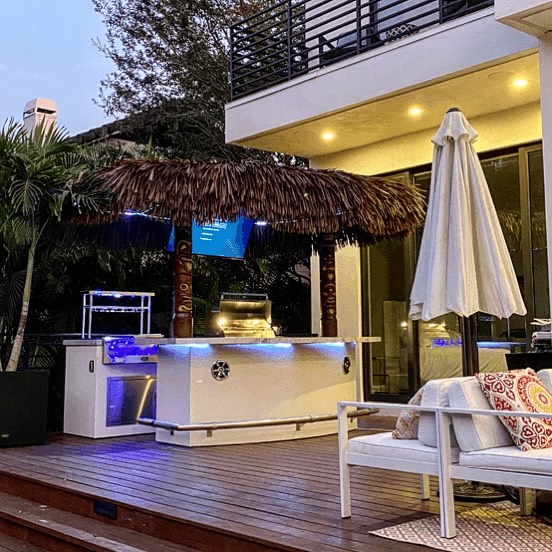
Between the wood and the water pan lies a thin line where everything can go wrong.
It’s that moment when the sun dips below the horizon, the ribs are hitting the six-hour mark, and you realize you’re trying to judge the mahogany bark of a brisket using nothing but the flashlight on your phone and a prayer.
I’ve been there – balancing a beer in one hand and a set of tongs in the other, squinting into the smoky abyss of a 500°F grill.
In the world of professional-grade outdoor kitchens, lighting isn’t just about “vibes” or showing off your expensive stonework. It is a fundamental safety requirement.
When you are dealing with high-heat outdoor cooking areas, standard patio lights from a big-box store just won’t cut it. They melt, they flicker, and occasionally, they pop like a firecracker when a plume of 600-degree heat hits them.
To cook like a pro, you need to see like a pro.
Here are five safety-first lighting ideas to ensure your midnight sear doesn’t turn into a call to the local fire department.
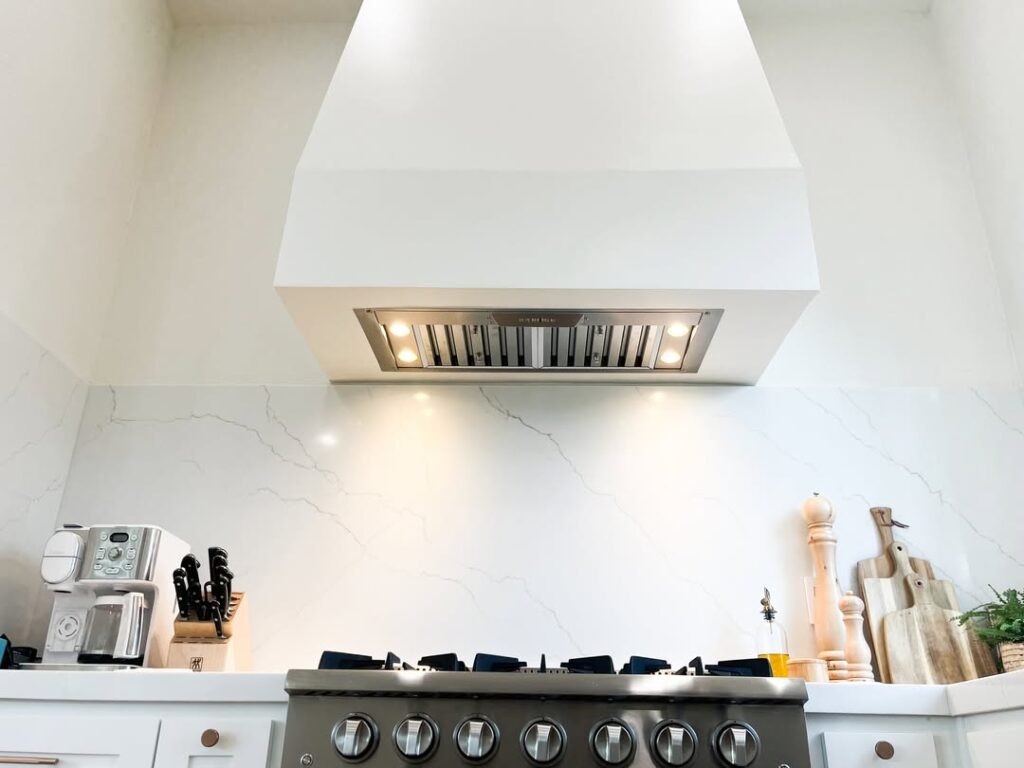
1. Hood-Mounted High-Heat Halogens
Most people are obsessed with LEDs these days, and for good reason – they’re efficient and last forever. But in the “blast furnace” zone of a high-end grill, LEDs have a major weakness: they hate heat.
If you’ve ever seen an LED bulb turn a sickly shade of blue before dying, you’ve witnessed thermal failure.
This is where the “old school” halogen comes back into play. Hood-mounted high-heat halogens are the heavy lifters of the grilling world.
These bulbs are specifically designed to live inside the belly of the beast. They utilize tempered glass lenses that can withstand the thermal shock of a flare-up without shattering into your expensive Wagyu ribeye.
Why it’s a safety win: Seeing the “sear” isn’t just about aesthetics; it’s about fire management. When you can see the fat rendering and the exact moment a flare-up begins, you can react before the grease fire takes hold.
Integrating these lights directly into the grill hood provides a focused beam right where the action happens.
Just remember: these bulbs get hot enough to cook an egg on their own, so always let the grill cool completely before you try to wipe the grease off the lens.
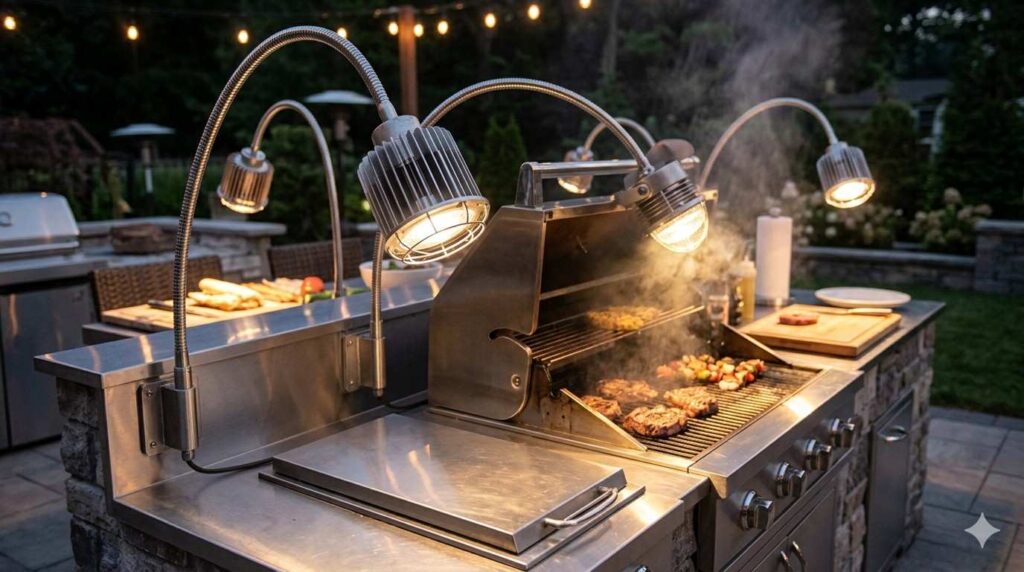
2. Heat-Shielded LED Gooseneck Task Lights
If you aren’t ready to drill holes into your grill hood, the next best thing is a specialized task light. But I’m not talking about those plastic clip-on lights that look like they belong on a dorm room desk.
For a high-heat zone, you need a heat-shielded LED gooseneck.
The “secret sauce” here is the construction. Look for fixtures made from 304-grade stainless steel with active heat sinks. These lights are designed to dissipate the heat that rises from the grill grates so the internal circuitry doesn’t fry.
The gooseneck feature is a massive safety advantage because it allows for directional illumination.
You can angle the light to see deep into the back of the grill – where the “hot spots” usually hide – and then swing it away when you’re doing a high-heat burn-off.
The Pitmaster’s Tip: Position your task light so it illuminates your prep area and your grill surface simultaneously. There is nothing more dangerous than moving a piping hot tray of meat from a bright grill to a pitch-black side counter.
Lighting the transition zone prevents the dreaded “brisket drop” of 2026.
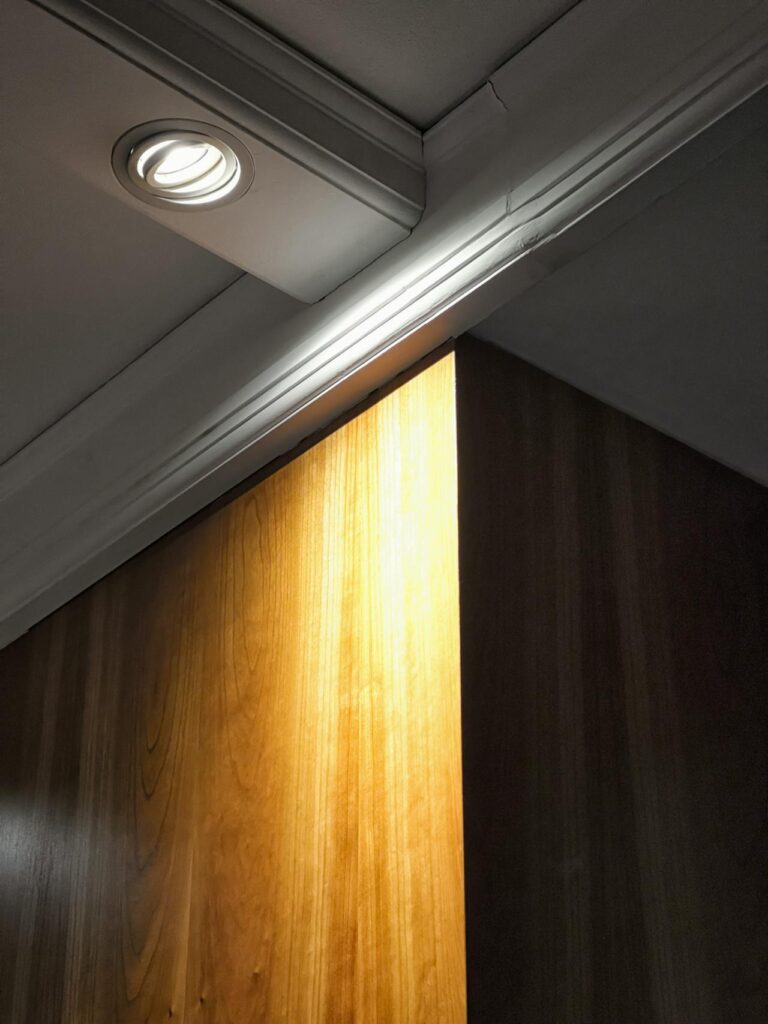
3. Recessed Ceiling Soffit Lights with Fire-Rated Housings
If you’re lucky enough to have a luxury outdoor kitchen under a pergola or a permanent roof extension, you need to think about overhead safety. Many homeowners make the mistake of installing standard indoor recessed cans.
In an outdoor cooking environment, the rising heat and grease vapor can turn those standard fixtures into a fire hazard.
Fire-rated housings are non-negotiable here.
These are specialized canisters that act as a barrier, preventing heat from escaping into the ceiling cavity. When you place these lights 4 to 6 feet above the cooking surface, you create a beautiful “wash” of light that covers the entire zone.
Strategic Placement: Don’t put the lights directly behind where you stand. If you do, you’ll spend the whole night casting a giant shadow over your food, essentially cooking in the dark anyway.
Offset them slightly or use multiple fixtures to ensure cross-beam illumination. This eliminates shadows and ensures that when you’re slicing through a tenderloin, you can see exactly where the knife meets the meat – and where your fingers are.
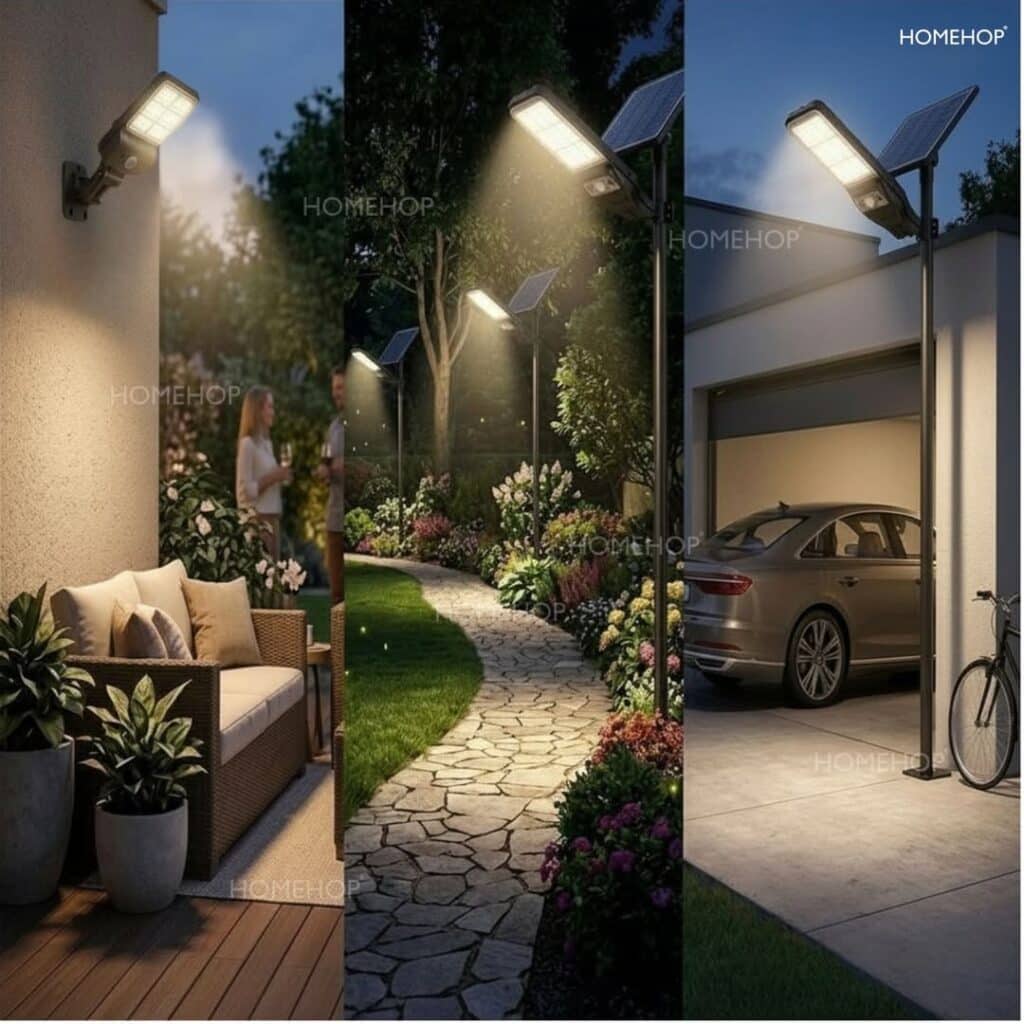
4. Remote-Operated Solar Perimeter Lighting
Gas and electricity are like that one couple that’s always fighting – they’re better off with some distance between them.
In a high-heat cooking area, the last thing you want is a complex web of high-voltage wires running right next to your gas manifold or charcoal hopper.
Solar perimeter lighting has come a long way from the dim “marker lights” of the early 2000s. Modern, high-output solar fixtures allow you to light the surrounding area without pulling a single wire.
By using remote-operated units, you can kick the brightness up to “stadium mode” when it’s time to clean up and dial it back to “ambiance mode” when it’s time to eat.
The Safety Factor: These lights are fantastic for “ambient safety.” They illuminate the floor, the edges of the patio, and the path to the trash can. In the heat of the moment (pun intended), you’re going to be moving fast.
Knowing exactly where the step is or where the dog left his toy prevents the kind of trips and falls that end with a trip to the ER.
Plus, since they’re low-voltage or solar, there’s zero risk of an electrical short if a grease fire happens to get out of hand.
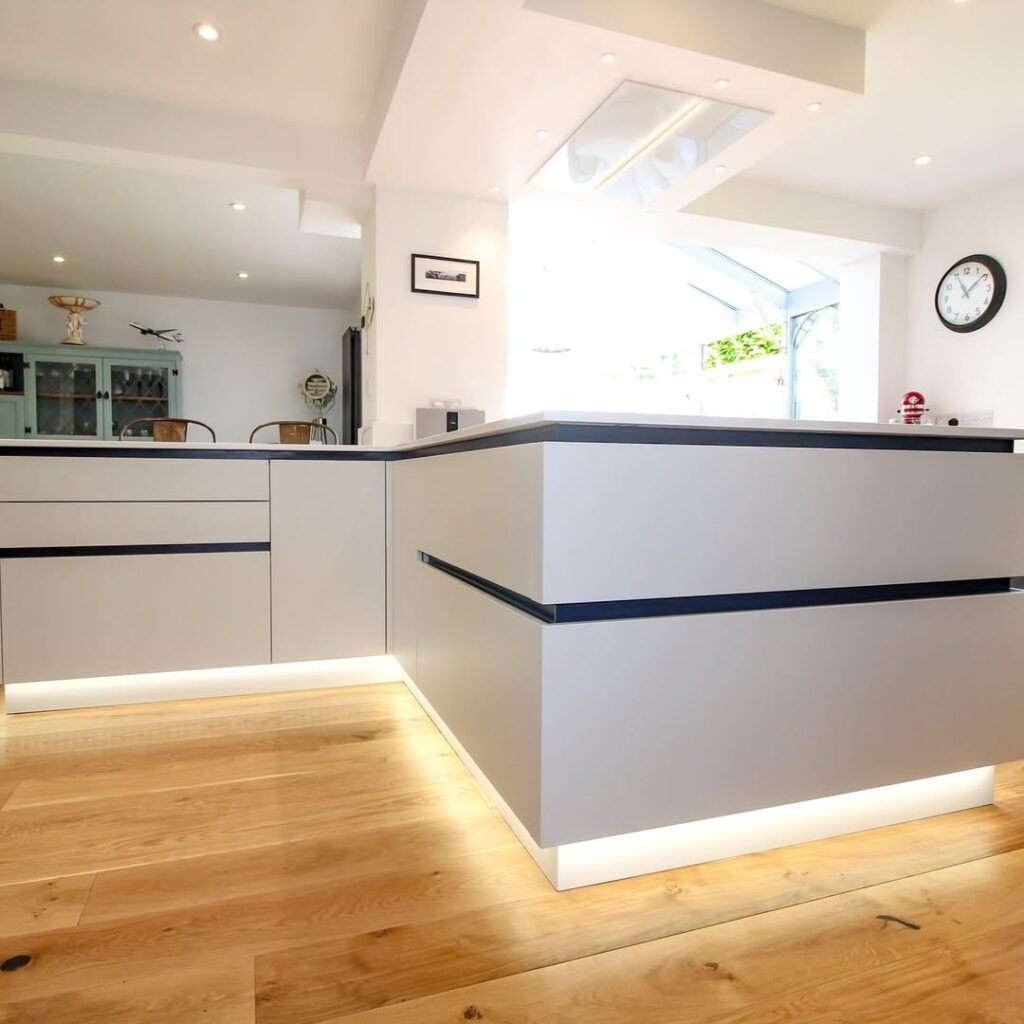
5. Under-Counter LED Strips with Thermal Gaskets
We spend so much time looking at the grill grates that we forget about the infrastructure. You need to see your knobs, your fuel gauges, and your storage drawers.
Trying to swap out a propane tank in the dark is a recipe for a leak.
Under-counter LED strips equipped with thermal gaskets are the solution. These are encased in thick, heat-resistant silicone (look for an IP67 rating). They tuck neatly under the lip of your countertop, casting light downward onto your equipment.
The “Why”: Being able to see your gas shut-off valve is a critical safety requirement. If you smell gas or see a malfunction, you need to find that valve in three seconds, not thirty.
Under-counter lighting ensures that every dial and connection is visible at a glance. It’s the difference between a controlled cooking environment and a chaotic one.
The Technical Buyer’s Guide: Lumens and Kelvins
Before you run out and buy the brightest lights you can find, let’s talk shop for a second. In the kitchen, color matters. If your lights are too “cool” (high Kelvin), your meat will look grey and unappetizing.
If they’re too “warm,” everything looks yellow, and you won’t be able to tell the difference between “perfectly medium” and “burnt to a crisp.”
- The Sweet Spot: Aim for 3000K to 4000K. This is a neutral white that mimics natural sunlight, giving you the most accurate representation of food color.
- The Brightness Rule: You want about 50 to 100 lumens per square foot for the cooking surface itself. Any brighter and the glare off the stainless steel will actually make it harder to see.
Maintenance: The “Clean Lens” Protocol
Grease is the enemy of light. In a high-heat environment, atomized fat rises with the smoke and coats everything – including your expensive light lenses. Over time, this grease bakes onto the glass, dimming the output and creating a fire hazard of its own.
Make it a habit to wipe down your light lenses with a citrus-based degreaser every three or four cooks. Wait until the fixtures are cool, obviously.
I once tried to clean a halogen lens while it was on; let’s just say the smell of singed microfiber is not a spice I recommend for your ribs.
Final Thoughts
At the end of the day, your outdoor kitchen is an extension of your home. You’ve put the work into the masonry, the grill selection, and the recipe development. Don’t let the whole experience fall apart because you skimped on the safety-first lighting ideas.
Good lighting makes you a better cook. It gives you the confidence to push your sear to the limit, the clarity to handle your cutlery safely, and the peace of mind to enjoy the process.
So, ditch the headlamp and the iPhone flashlight. Invest in high-heat-rated gear that can stand the pressure. Your brisket – and your eyebrows – will thank you.
Now, if you’ll excuse me, I have a rack of ribs calling my name, and for the first time in years, I can actually see what I’m doing.
Happy grilling!
Frequently Asked Questions: Illuminating the Heat Zone
Setting up a high-end outdoor kitchen involves more than just plugging in a few lamps. Here are the most common questions I get from fellow pitmasters looking to upgrade their nighttime setup.
Q: Can I just use standard indoor LED bulbs if my grill is under a high ceiling?
A: I wouldn’t recommend it. Even with a high ceiling, convection heat and grease vapors rise rapidly. Standard indoor LEDs aren’t built to handle the humidity or the oily film of a BBQ environment.
You’ll find the plastic housings yellowing or the “driver” (the brains of the bulb) failing within a few months. Stick to IP65 or IP67-rated outdoor fixtures for longevity.
Q: Are halogen bulbs “safe” given how hot they get?
A: Yes, provided they are in a tempered glass housing. Halogens are actually more “comfortable” in high ambient temperatures than LEDs. The key is the fixture design.
Ensure your halogen setup is integrated or shielded so you don’t accidentally touch the bulb while reaching for a burger.
Q: How many lumens do I actually need for a 36-inch grill?
A: Aim for approximately 1,500 to 2,000 lumens focused directly on the cooking surface. This provides enough “punch” to see through the smoke without being so bright that the reflection off your stainless steel grates blinds you. Think “bright moonlight,” not “operating room.”
Q: Why does my lighting make my medium-rare steak look grey?
A: You likely have bulbs with a low Color Rendering Index (CRI) or a color temperature that is too “cool” (5000K+). For culinary work, you want a CRI of 90 or higher and a color temperature around 3000K.
This ensures reds and browns look natural, which is critical for judging the “doneness” of your meat.
Q: What is the best way to clean smoke and grease off my light lenses?
A: Wait until the grill and the lights are completely cool. Use a microfiber cloth and a mild degreaser or a 50/50 mix of vinegar and water.
Avoid abrasive sponges, as scratches on the lens will catch the light and create a distracting glare the next time you cook.
Q: Do solar lights really provide enough brightness for actual cooking?
A: For the grill surface itself? Usually not. But for perimeter and path safety, they are excellent.
Use solar power to light the way to the cooler or the trash bin, but keep your task lighting (where the knives and fire are) hardwired or high-output battery-powered.
Final Note: If you’re ever in doubt about an installation near a gas line, call a pro. It’s better to pay an electrician for an hour of work than to explain to your insurance company why your pergola is now a giant campfire.
Featured image credit: @paradisegrills
