
What most backyard cooks don’t realize is that your grill is basically a heat engine – just one that smells like steak instead of diesel.
Some folks blame bad results on the meat. Others blame the grill. But nine times out of ten, the real issue is simple: poor heat management. That’s where a proper thermodynamic tune-up comes in.
Think of it like dialing in an engine. You’re not changing the machine – you’re making it run the way it was meant to. Cleaner burn. Better heat. Less wasted fuel. And yeah, tastier food.
I’ve spent enough time behind grills and smokers to know this: once you understand the science, everything clicks. Your temps stabilize. Your fuel lasts longer. Your food cooks more evenly.
And the best part? You don’t need a lab coat. Just a little curiosity – and maybe fewer unnecessary lid peeks (we’ll get to that).
Understanding Grill Efficiency
Let’s keep this simple and practical.
Grill efficiency = how much of your fuel’s energy actually cooks your food.
Not how hot your grill gets. Not how expensive your charcoal is. Not how impressive your setup looks on Instagram.
Just this:
- How much energy goes in
- How much useful heat comes out
Everything else? Loss.
And grills lose heat like a screen door loses air conditioning.
Where efficiency falls apart:
- Heat escaping through gaps and thin metal
- Uneven heat zones
- Poor airflow choking combustion
- Opening the lid every 30 seconds like you’re checking on a sleeping baby
Here’s the kicker: inefficiency doesn’t just waste fuel – it wrecks consistency. One side of your grill is scorching, the other barely cooking. That’s not character. That’s chaos.
A proper thermodynamic tune-up fixes that. It turns your grill from a guesswork machine into a controlled system.
The Thermodynamics Behind Grilling
Don’t worry – this isn’t a lecture. This is just understanding why your steak sometimes comes out perfect… and sometimes looks like it lost a fight.
The First Law of Thermodynamics (a.k.a. nothing gets lost, just misplaced)
Energy doesn’t disappear. It just goes somewhere else.
In grilling terms:
- Fuel burns → creates heat
- That heat either:
o Cooks your food (good)
o Escapes into the air (bad)
Your job? Keep as much heat working for you as possible.
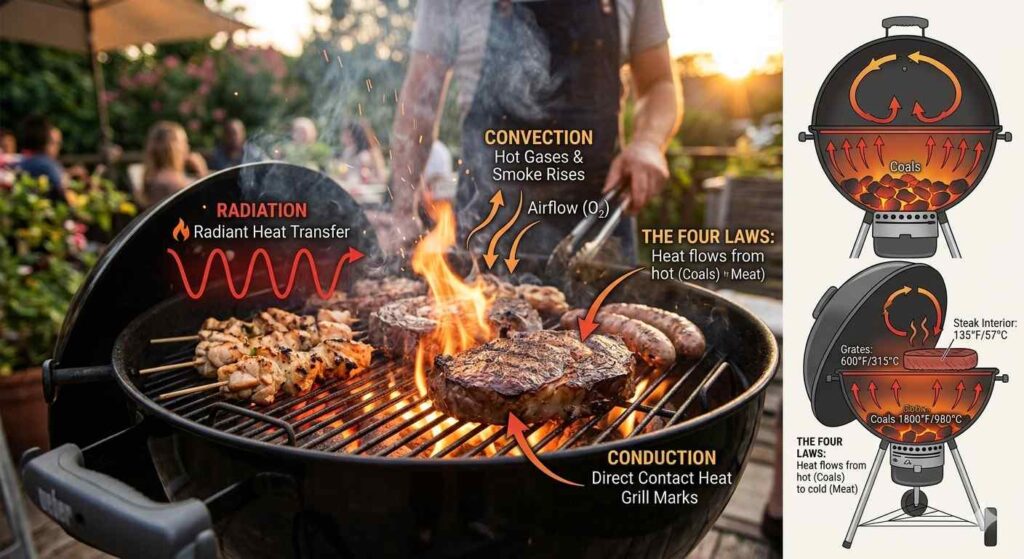
The Three Ways Heat Moves
Every grill uses all three. Master these, and you’re in control.
1. Conduction
Direct contact heat. Grates touching meat.
👉 This is where you get that crust. That sear. That “wow” moment.
2. Convection
Hot air moving around your food.
👉 This is what cooks things evenly – like a mini oven with attitude.
3. Radiation
Infrared heat from flames, coals, or burners.
👉 This is your power hitter. Fast. Intense. Slightly unforgiving.
The Sneaky Villain: Entropy
In plain English: heat wants to escape.
It leaks out of:
- Thin metal walls
- Loose lids
- Open vents
- Every time you lift the lid “just to check”
A thermodynamic tune-up is really about fighting that escape. Slowing it down. Redirecting it.
Because once heat leaves your system, it’s not coming back with an apology.
Fuel Types and Energy Density
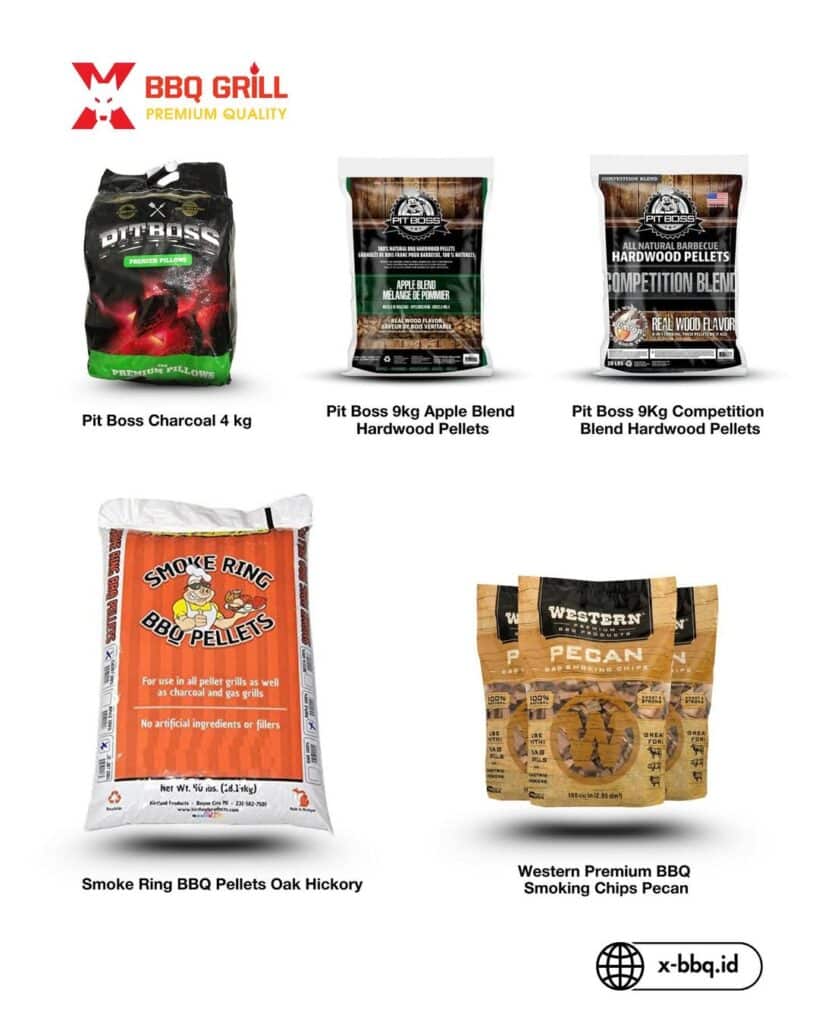
Not all fuels are created equal. Some burn hot and fast. Others slow and steady. Some give you flavor. Others give you convenience.
Choosing the right one is part science, part preference – and part “what do I have in the garage right now?”
Charcoal
- Lump charcoal: burns hotter, cleaner, faster
- Briquettes: more consistent, longer burn
👉 Lump is like a sports car. Briquettes are your reliable pickup truck.
Gas (Propane/Natural Gas)
- Easy to control
- Burns clean
- Less radiant intensity
👉 Efficient? Yes. Romantic? Not exactly.
Wood (Chunks, Logs, Pellets)
· Lower efficiency
· High flavor payoff
👉 You lose some energy – but gain smoke, aroma, and personality.
The Engineer’s Take
Energy density matters. But control matters more.
You can waste high-quality fuel with poor airflow.
You can cook beautifully with basic fuel and good technique.
A proper thermodynamic tune-up isn’t about buying better fuel – it’s about using what you have more effectively.
Airflow: The Hidden Variable
If heat is the engine, airflow is the throttle.
- No oxygen = weak fire.
- Too much oxygen = runaway heat.
You need balance.
How airflow actually works:
- Intake vents feed oxygen
- Exhaust vents release gases and regulate flow
Think of it like breathing:
- Inhale (intake)
- Exhale (exhaust)
Mess that up, and things get ugly fast.
Signs your airflow is off:
- Thick, dirty smoke → not enough oxygen
- Flames going wild → too much airflow
- Temps won’t stabilize → imbalance
Practical tuning tips:
- Start with vents partially open, not wide open
- Make small adjustments – not big swings
- Give changes time to take effect (this isn’t instant messaging)
A clean-burning fire is what you want.
Thin, almost invisible smoke.
That’s when you know your thermodynamic tune-up is working.
Heat Retention and Grill Design
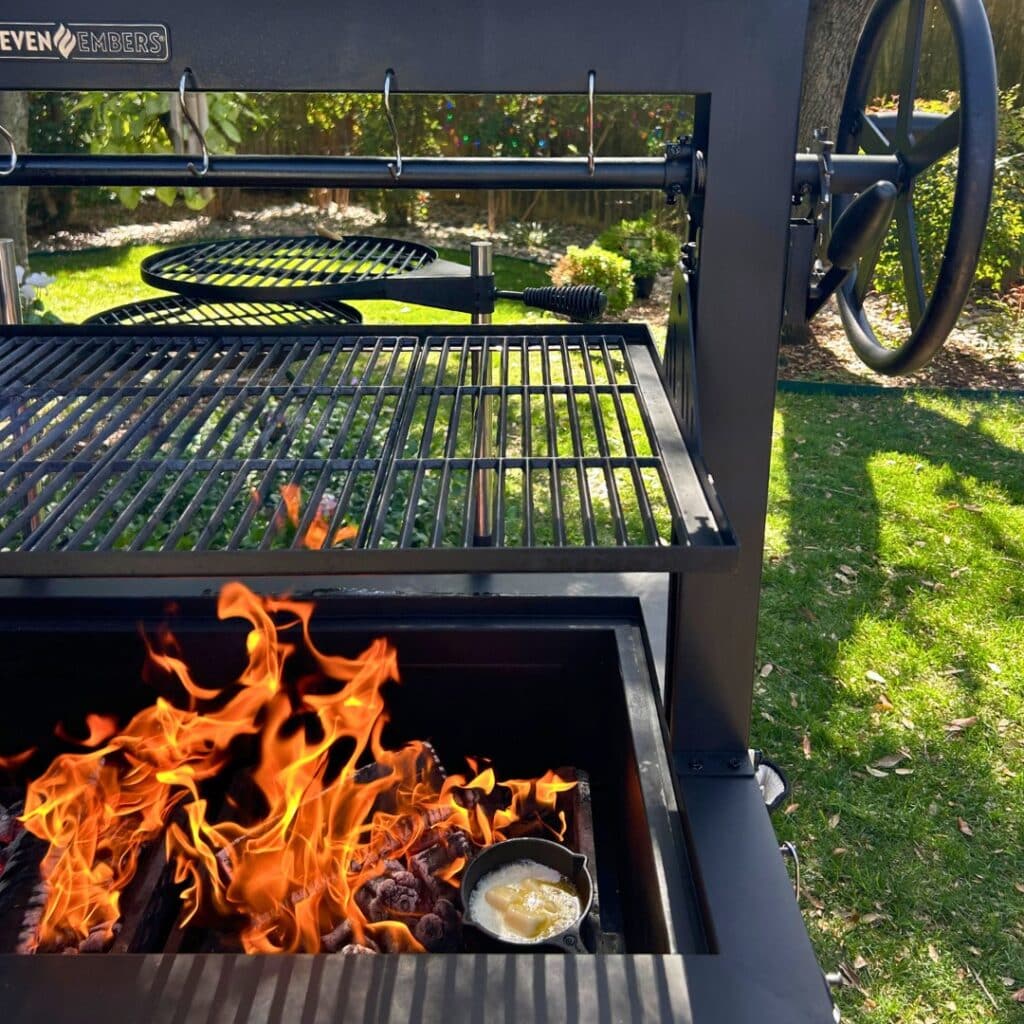
Some grills hold heat like a cast iron skillet. Others lose it like a paper cup.
Guess which one cooks better?
Materials make a difference:
- Thin steel → heats fast, loses heat faster
- Cast iron → holds heat well
- Ceramic (kamado-style) → insulation king
👉 A kamado grill is basically a thermos for fire. It’s almost unfair.
Thermal mass = stability
The more heat your grill can store, the less it fluctuates.
That means:
- Fewer temperature swings
- Less fuel consumption
- More consistent cooking
Lid design matters more than you think:
- Tight seal = less heat loss
- Loose lid = constant energy leak
Every gap is an escape route for heat.
A proper thermodynamic tune-up is often just:
- Sealing leaks
- Using better materials
- Letting the grill stabilize before cooking
Simple changes. Big results.
Heat Distribution and Hot Spots
Every grill has personality. Some just express it more aggressively. Hot spots happen. The trick is knowing how to use them – or fix them.
Why uneven heat happens:
- Burner placement
- Coal arrangement
- Airflow patterns
How to fix it:
- Two-zone setup
o One side hot
o One side cooler
👉 This gives you control. Sear here, finish there.
- Rearrange coals or burners
- Use heat deflectors when needed
Pro move: Map your grill
Throw some bread slices on the grates. See what burns first. Boom. You’ve got a heat map.
It’s low-tech, slightly ridiculous – and incredibly effective.
Measuring and Improving Efficiency
Engineers measure everything. Pitmasters? We learn by feel – but a little data never hurts.
Tools that actually help:
- Grill thermometers (don’t trust the lid gauge blindly)
- Infrared thermometer for surface temps
- Probe thermometers for food
What to pay attention to:
- How long it takes to preheat
- How much fuel you use per cook
- How stable your temperatures are
The Tune-Up Checklist:
- Clean out ash and grease
- Check for leaks
- Adjust airflow gradually
- Use the right amount of fuel (not “just in case” extra)
Then do what engineers do best:
Test → observe → adjust → repeat
That’s your thermodynamic tune-up in action.
Common Efficiency Mistakes
Let’s call these out, because we’ve all done them.
Opening the lid too often
Every time you do this, you dump heat.
👉 You’re not checking progress – you’re resetting the system.
Overloading fuel
More fuel ≠ better cooking.
It usually means:
- Less control
- More waste
- Higher chance of burning food
Poor maintenance
Ash buildup blocks airflow.
Grease buildup affects combustion.
👉 Dirty grill = inefficient grill.
Ignoring the weather
Wind steals heat.
Cold air slows everything down.
A good thermodynamic tune-up accounts for your environment – not just your grill.
Practical Case Study: From Wasteful to Efficient
I once worked with a guy who couldn’t figure out why his grill burned through charcoal like it owed him money.
Temps were unstable. Food cooked unevenly. Fuel disappeared fast.
Classic case.
The problems:
- Vents fully open (too much airflow)
- Lid didn’t seal properly
- Way too much charcoal
The fixes:
- Adjusted vents for controlled airflow
- Added a simple gasket for sealing
- Cut fuel load by about 30%
The result:
- Stable temps within 10 minutes
- Fuel lasted significantly longer
- Food cooked evenly
Same grill. Same cook.
Just a proper thermodynamic tune-up.
Thermal Emissivity and Surface Finish
To a mechanical engineer, the color and texture of your grill’s interior dictate thermal emissivity. While a shiny stainless steel interior looks sharp, it actually reflects radiant heat back toward the source, making your preheat less efficient.
- Carbonized Seasoning: As you develop a thin layer of black “gunk,” emissivity increases.
- The Radiant Absorber: This matte black surface becomes an elite absorber and emitter, soaking up coal energy and pumping it into your food.
- The Thermal Flywheel: Once a seasoned interior gets hot, it stays hot, creating a stable cooking environment.
The Tune-Up: Stop over-scrubbing the interior walls. Keep the grates clean, but let the firebox stay dark to master infrared transfer.
Boundary Layer Dynamics: The Searing Science
When hot air moves across a cold steak, it hits a thermal boundary layer – a thin cushion of stagnant air that acts as an insulator. To cook efficiently, you have to break that seal.
- Forced Convection: Use exhaust vent positioning or fans to create turbulent flow.
- Energy Delivery: Breaking the boundary layer allows hot gases to deliver energy to meat fibers more aggressively.
- The Nusselt Number: This measures how effectively you transfer heat via convection versus conduction.
The Tune-Up: To speed up a cook without cranking the heat, increase the velocity of the air. Stripping away that insulating air pocket is more efficient than just adding more fuel.
The Latent Heat of Evaporation (The “Stall”)
The “stall” isn’t a mystery; it’s a phase change. At roughly 160°F, the rate of evaporative cooling on the meat’s surface matches the heat input of the grill.
- Phase Change Energy: Your “engine” stays running, but the temp plateaus because energy is being consumed by the latent heat of vaporization.
- Humidity Management: Adding a water pan increases relative humidity, which slows evaporation and pushes the meat through the stall faster.
- The Closed System: “Wrapping” meat in foil eliminates evaporative cooling entirely by trapping steam.
The Tune-Up: Recognize this thermodynamic plateau early so you can decide exactly when to spend your fuel and when to wrap.

Thermal Bridging and Gasket Integrity
In high-performance systems, thermal bridging is a silent efficiency killer. This happens when heat escapes through highly conductive paths like hinges, bolts, or loose lids.
- Pressure Leaks: Gaps in the lid cause “short-circuiting,” where oxygen bypasses the fuel and heads straight for the exhaust.
- The Nomex Solution: Installing high-temperature gaskets creates an airtight, pressure-neutral environment.
- Responsive Control: Sealing leaks makes your vent adjustments feel like a precision instrument rather than a guessing game.
The Tune-Up: Treat your grill like a vacuum system. A sealed lid stabilizes your “idle” and gives you total burn rate precision.
Heat Sink Management: The Cold Mass Problem
Ignoring thermal mass inertia leads to the “thermal roller coaster.” Tossing a large, cold brisket or a heavy cast-iron pot into a freshly heated grill causes the system temperature to crater.
- Sensible Heat Storage: The meat and cookware act as heat sinks, draining energy from the air and walls.
- Steady-State Condition: Engineers wait for the system to fully stabilize before beginning work.
- Heat Soaking: Allowing the grill to sit for 20 minutes after hitting the target temp ensures the hardware is saturated with energy.
The Tune-Up: Give your grill time to store enough thermal energy to recover instantly once the cold food is introduced.
Stoichiometry: Achieving the Perfect Burn
In combustion science, the stoichiometric ratio is the perfect air-to-fuel balance. Achieving this in a grill results in the legendary “blue smoke.”
- Rich Mixture: Too much fuel and too little oxygen causes incomplete combustion, producing bitter soot and creosote.
- Lean Mixture: Too much air wastes energy by heating up excess nitrogen that simply blows out the chimney.
- Chemical Potential: The “sweet spot” features glowing coals and nearly translucent exhaust.
The Tune-Up: Aim for maximum chemical energy potential. A balanced burn leads to a cleaner flavor profile and a significantly longer-lasting fire.
Think Like an Engineer, Cook Like a Legend
Here’s the truth: grilling isn’t just cooking—it’s applied thermodynamics with smoke and fire.
Once you understand how heat moves, how fuel burns, and how airflow behaves, everything changes.
You stop guessing.
You start controlling.
And the results?
- Better flavor
- More consistency
- Less wasted fuel
A thermodynamic tune-up doesn’t require fancy gear or complicated math. Just attention, small adjustments, and a willingness to learn your grill.
Dial it in like an engineer.
Run it like a pitmaster.
And let the fire do exactly what you tell it to. 🔥
Frequently Asked Questions: Thermodynamic Tune-Up & Grill Efficiency
1. What is a “thermodynamic tune-up” for a grill?
A thermodynamic tune-up is the process of optimizing how your grill uses heat and fuel. It means improving airflow, reducing heat loss, and managing fuel so more energy goes into cooking your food – not escaping into the air.
Think of it like fine-tuning an engine so it runs smoother, hotter, and more efficiently without wasting resources.
2. Does grill efficiency really affect food quality?
Absolutely. Efficient heat = consistent cooking. When your grill holds steady temperatures, your food cooks evenly, develops better crust, and avoids burning or undercooking.
Poor efficiency leads to hot spots, flare-ups, and unpredictable results – basically the difference between a perfectly seared steak and one that looks confused.
3. What’s the biggest mistake people make with grill efficiency?
Opening the lid too often.
Every time you lift it, you release a huge amount of heat and disrupt airflow. It forces your grill to work harder to recover, wasting fuel and time. If you’re constantly checking, you’re not cooking – you’re sabotaging your own thermodynamic tune-up.
4. Which fuel is the most efficient for grilling?
It depends on your goal.
- Gas is typically the most efficient and controllable
- Charcoal (briquettes) offers steady, longer burns
- Lump charcoal and wood provide higher heat and better flavor but less efficiency
The key isn’t just the fuel – it’s how well you manage it during your thermodynamic tune-up.
5. How do I know if my grill has poor airflow?
Watch the smoke and flame behavior:
- Thick, dark smoke → not enough oxygen
- Weak heat → restricted airflow
- Wild flames → too much oxygen
A properly tuned grill produces clean, thin smoke and steady heat. That’s your signal everything is balanced.
6. Do I need expensive equipment to improve grill efficiency?
Not at all. Most improvements come from technique, not tools.
Simple upgrades like:
- Adjusting vents properly
- Cleaning out ash
- Sealing lid gaps
These make a bigger difference than buying fancy gear. A good thermodynamic tune-up is more about awareness than spending money.
7. Why does my grill have hot spots, and can I fix them?
Hot spots happen due to uneven heat distribution from burners, coals, or airflow patterns.
You can fix or manage them by:
- Setting up a two-zone fire
- Rearranging coals or burners
- Using heat deflectors
Or embrace them – use hot spots for searing and cooler zones for finishing.
8. How does weather affect grill efficiency?
More than you think.
- Wind pulls heat away and disrupts airflow
- Cold air lowers overall temperature
- Humidity can affect combustion slightly
A solid thermodynamic tune-up accounts for these factors by adjusting airflow and fuel accordingly.
9. How can I measure if my grill is becoming more efficient?
Look for these signs:
- Faster preheat times
- Less fuel used per cook
- More stable temperatures
- Better, more consistent food results
If your grill feels easier to control, your thermodynamic tune-up is working.
10. Is grill efficiency more important than grill type?
In many cases – yes.
A well-managed basic grill can outperform an expensive one that’s poorly used. Technique, airflow control, and heat management matter more than brand names.
Because at the end of the day, fire doesn’t care how much you paid for the grill – it only responds to how well you run it. 🔥
Featured image credit: Mikhail Nilov
