
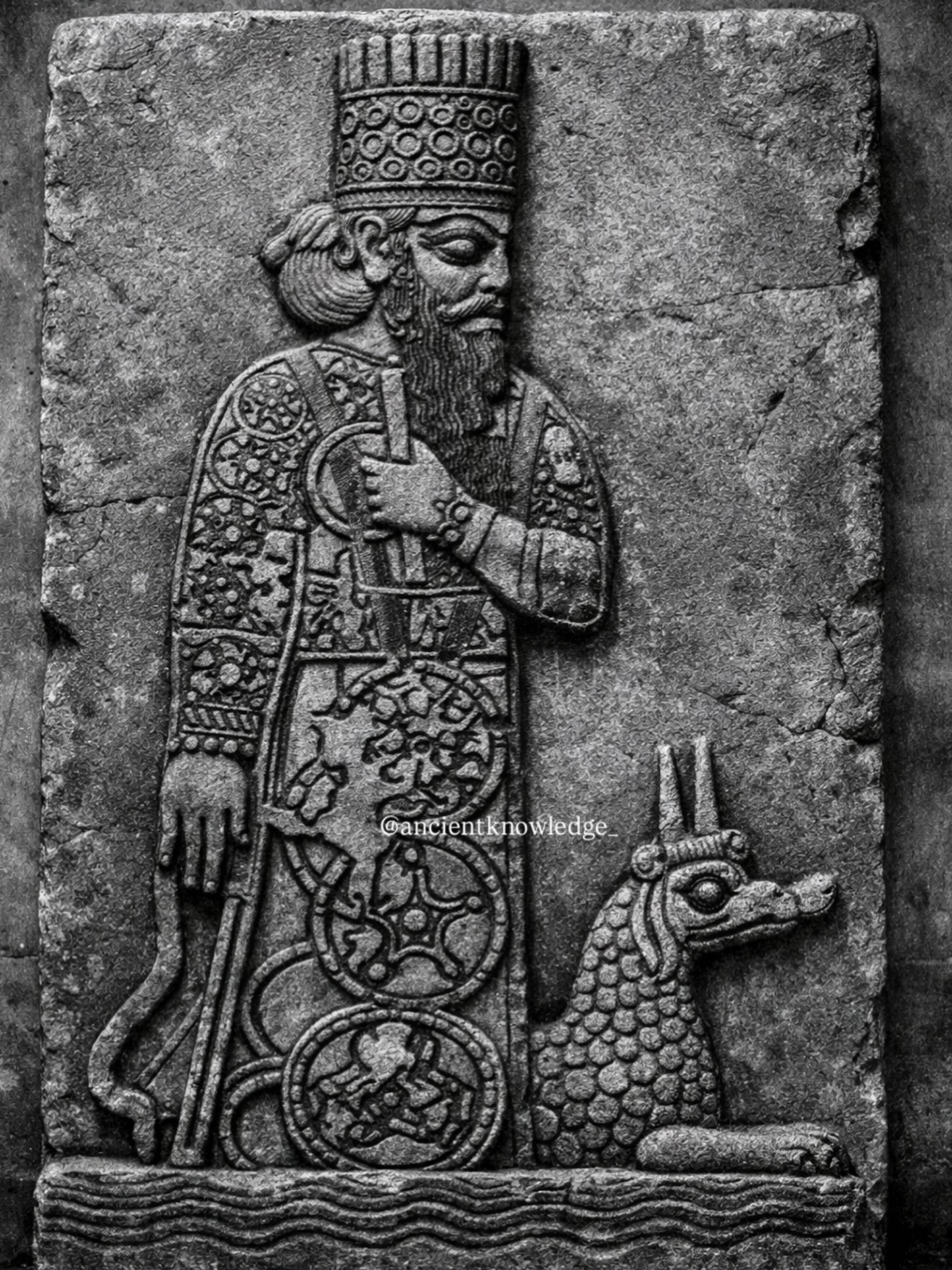
Modern wellness influencers love telling everyone that our ancient ancestors survived on crisp mountain air, plain spring water, and raw kale.
That is absolute nonsense.
Four thousand years ago in the dusty, sun-baked plains of Mesopotamia, the greatest civilization on Earth was fueled entirely by heavy ale and slow-roasted meat.
Forget the pristine salads. The Mesopotamians built the literal cradle of civilization on a foundation of liquid calories and flame-kissed fat. Standing right at the center of this glorious, grease-stained universe was Marduk, the undisputed supreme deity of Babylon.
While modern religions often preach austerity, fasting, and self-denial, the Mesopotamians knew the ultimate truth: a happy god is a well-fed god.
Understanding how the king of the Mesopotamian pantheon demanded his daily feast reveals that the connection between a blazing fire pit, a foamy mug, and spiritual enlightenment isn’t new. It is one of the oldest traditions in human history.
The Rise of Babylon’s Supreme Meathead
Every great backyard cookout needs a host, but Babylon took things to an entirely different level. Marduk did not start out as the ruler of the universe.
In the early days of Mesopotamia, he was just a minor local deity tasked with watching over a small agricultural village along the Euphrates River.
As Babylon grew from a muddy outpost into a powerhouse, Marduk received a massive promotion. To justify his sudden ascension over older, established deities, ancient Babylonian scribes penned the Enuma Elish – the ultimate mythological hype story.
- The Cosmic Brawl: The myth claims the universe was threatened by Tiamat, a terrifying dragon representing primordial chaos.
- The Ultimatum: While the old gods cowered in fear, Marduk stepped forward with a simple proposition: “I’ll crush the dragon, but only if you make me the absolute boss forever.”
- The Victory: Armed with a net, a club, and fierce winds, Marduk defeated Tiamat and split her body to create the heavens and the earth.
After saving existence, Marduk created humanity for one specific, highly relatable reason: he wanted someone to do the chores and cook his dinner. Human existence wasn’t created for abstract theological contemplation.
Mankind was engineered to farm the grain, brew the beer, and keep the fire pit stoked for the gods.
Liquid Gold: Why Beer Was Divine Law
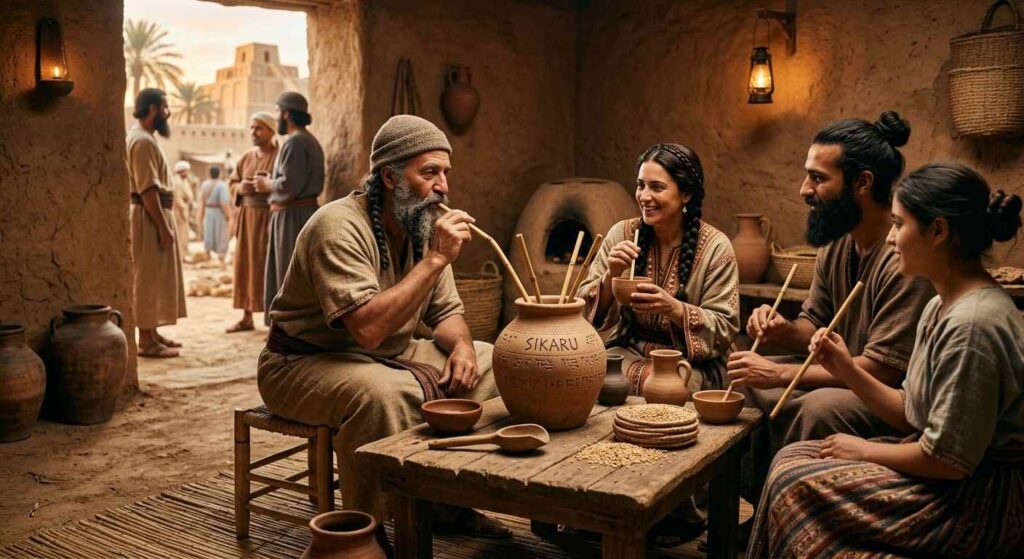
Nothing goes with roasted meat quite like a cold brew, and the ancient Babylonians treated their ale with absolute reverence. Water in ancient Mesopotamia was notoriously sketch – full of silt, bacteria, and agricultural runoff. Beer (sikaru) was life-saving, nutritious, and deeply sacred.
Ancient Babylonian beer was not the clear, fizzy lager sitting in a modern ice chest. It was a thick, unfiltered, highly aromatic beverage packed with floating barley husks and wild yeast sediment.
People drank it through long reed straws to filter out the solid debris floating on top.
The Ultimate Ale Menu
The priests inside Marduk’s grand temple complex, the Esagila, maintained strict brewing standards for the god’s daily libations:
- Red Beer (Sikaru Huššû): A deeply rich, amber-hued brew spiced with local herbs and toasted grains.
- Fine Dark Beer: A heavy, sweet stout-like ale loaded with unrefined sugars and roasted barley.
- Filtered Prime Ale: A smooth, strained beer saved exclusively for high-ranking rituals and top-tier divine offerings.
To the Babylonians, pouring a fresh pint for Marduk was not just an act of devotion. It was a cosmic bribe.
The god of storm and creation controlled the spring rains. If his beer cup ran dry, the crops withered, the canals dried up, and the kingdom fell apart.
A steady supply of cold ale kept the cosmos turning smoothly.
Heavenly Ribs: The Science of Divine Barbecue
While beer kept the god refreshed, the real star of the show was the meat. In ancient Babylon, the average citizen lived primarily on a plant-based diet of chickpeas, lentils, dates, and barley porridge.
Eating fresh meat was a rare luxury reserved for major festivals, military victories, or wealthy elites.
For Marduk, however, every single day was an all-you-can-eat steakhouse.
| Meat Cut | Theological Significance |
| Fattened Bull Shoulder | Represented raw power, strength, and rule |
| Prime Prime Ribs | The prized center-cut; ultimate rich flavor |
| Whole Roasted Rams | Symbolized fertility, wealth, and abundance |
| Pomegranate Wild Fowl | Exotic, sweet delicacies reserved for gods |
The priests did not just slap raw meat on an altar and walk away. Mesopotamian temple kitchens functioned like high-volume, professional smokehouses. They understood heat control, fat rendering, and flavor layering better than almost anyone in the ancient world.
Seasoning Fit for a King
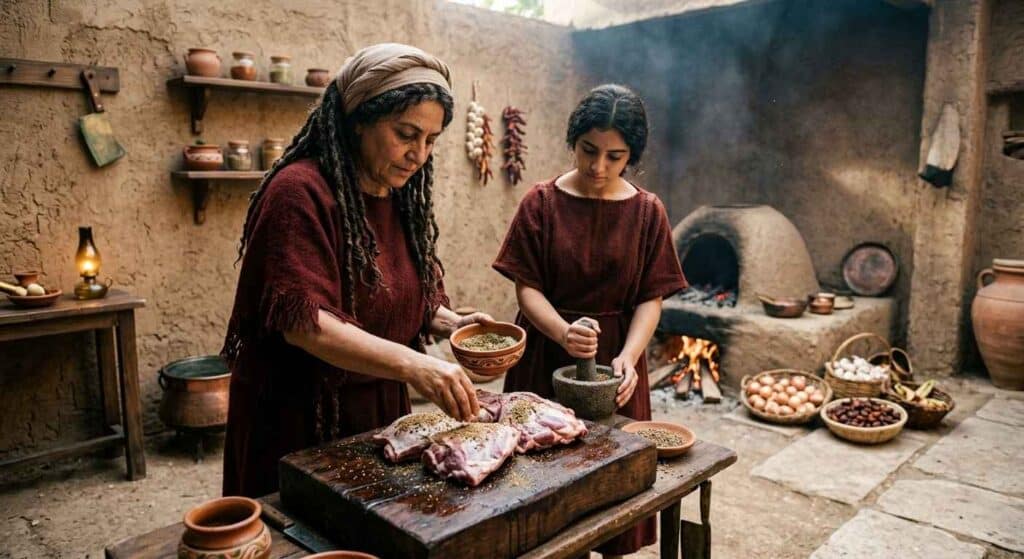
Babylonian cooks were culinary masters. Cuneiform tablets discovered by archaeologists reveal complex recipes for meats prepared for Marduk:
- Aromatic Wood: Fires were fueled with sweet-smelling cedar, juniper, and tamarisk wood to infuse the meat with clean, aromatic smoke.
- Spice Rubs: Meats were seasoned heavily with coriander, cumin, garlic, wild leeks, and salt harvested from desert flats.
- Fruit Glazes: Priests basted roasts with mixtures of date syrup, pomegranate juice, and rendered animal fat to create a sticky, caramelized crust over live coals.
The goal was simple: produce an intoxicating aroma so irresistible that Marduk couldn’t help but look down favorably on the city of Babylon.
A Day at the Esagila: How to Serve a God
Cooking a feast for a deity who lives in a massive golden statue requires extreme precision. Inside the Esagila – the massive temple complex featuring the famous towering ziggurat – a sprawling army of priests, butchers, and bakers worked in shifts around the clock.
- 06:00 AM — The Morning Service: Fire pits stoked; prime cuts roasted over hardwoods while fresh loaves of barley bread and fruit galettes were baked.
- 08:00 AM — The First Meal (Mākalū): Massive platters arranged before Marduk’s statue and linen curtains drawn for divine privacy.
- 05:00 PM — The Evening Feast: Second massive round of roasted meats and dark ales served alongside burning incense to carry aromas upward.
The Sacred Privacy Curtain
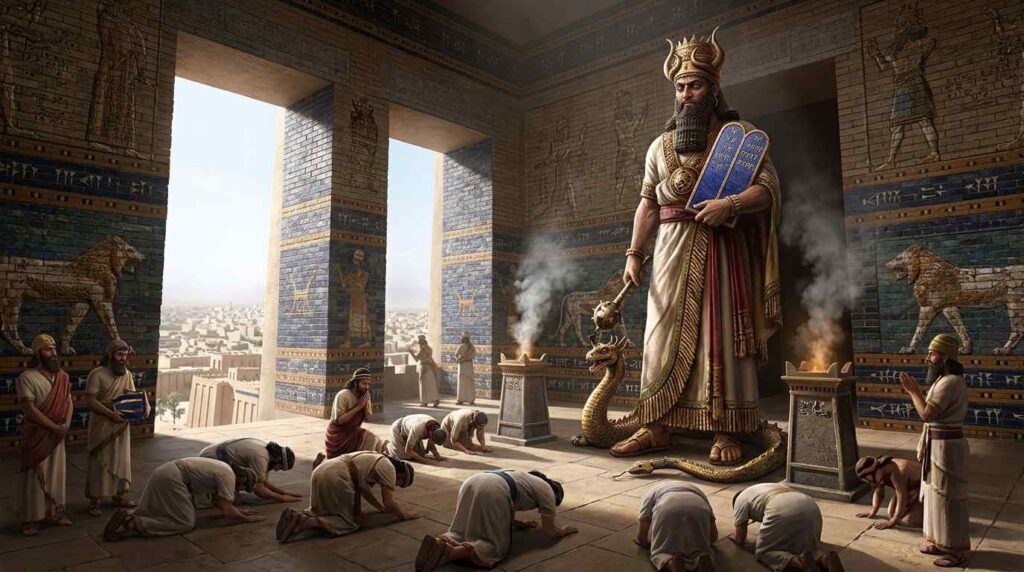
Once the hot, sizzling platters of meat and jars of fresh beer were brought into the inner sanctum and placed before Marduk’s solid gold statue, something fascinating happened. The priests pulled a heavy linen curtain closed.
The Babylonians were not naive. They knew a golden statue was not going to pick up a fork and start chewing. Theologically, they believed Marduk entered the statue spiritually to absorb the essence, aroma, and nutritional soul of the food.
Humans ate with their mouths; gods consumed through smell and spiritual presence. For thirty minutes, the room remained dead silent while the god silently “feasted.”
Who Ate the Leftovers?
Once the curtain was pulled back, the physical meat and beer remained on the table, looking delicious and fully cooked. What happened to all those prime ribs and fresh ales?
Nothing went to waste. The food became known as remaut (divine leftovers). Because the god had already absorbed the spiritual essence, the remaining physical food was considered supercharged with divine blessings.
- The King’s Portion: The highest quality cuts were immediately sent to the royal palace for the King of Babylon and his family.
- The Temple Staff: The priests, musicians, butchers, and cooks ate like royalty every single day off the god’s secondary menu.
- Political Bribes: High-ranking foreign ambassadors and visiting dignitaries were treated to Marduk’s leftover feasts to impress them with Babylon’s massive wealth and culinary superiority.
The Akitu Festival: The Ultimate 12-Day Barbecue
If the daily meals were impressive, the annual Akitu Festival was the ultimate food event of the ancient world. Held every spring during the barley harvest, this twelve-day New Year extravaganza brought the entire empire to a complete standstill.
| Festival Days | Primary Ritual & Culinary Activity |
| Days 1 – 4 | Purification rituals, temple prep, mass brewing |
| Day 5 | The King is humbled; priests prepare grand hearths |
| Days 6 – 8 | Public processions; mass livestock slaughters begin |
| Days 9 – 10 | The Grand Feast at the Bit Akitu (House of New Year) |
| Days 11 – 12 | Final divine decrees, cosmic renewal, public partying |
The Akitu Festival was designed to accomplish two things: prove that Marduk still ruled the universe, and prove that the King of Babylon was his chosen representative on Earth.
Mass Consumption on an Imperial Scale
During the peak days of the festival, the city transformed into an open-air feast. Thousands of cattle, sheep, and goats were driven into the city streets.
The air across Babylon hung thick with the heavy scent of hardwood smoke, rendering fat, and sweet, fermenting grain.
Huge open-flame hearths lined the sacred Processional Way, feeding both the elite priests inside the walls and the thousands of common citizens, pilgrims, and travelers celebrating outside.
The king personally funded thousands of gallons of beer for the public. It was the ultimate political move. A populace stuffed with free smokehouse meats and fine barley ale rarely revolts.
What Marduk’s Appetite Teaches Us Today
It is easy to look back at ancient Mesopotamian rituals and laugh at the idea of dressing up a golden statue and serving it a platter of short ribs. But looking past the ancient mythology reveals a profound, enduring truth about human nature.
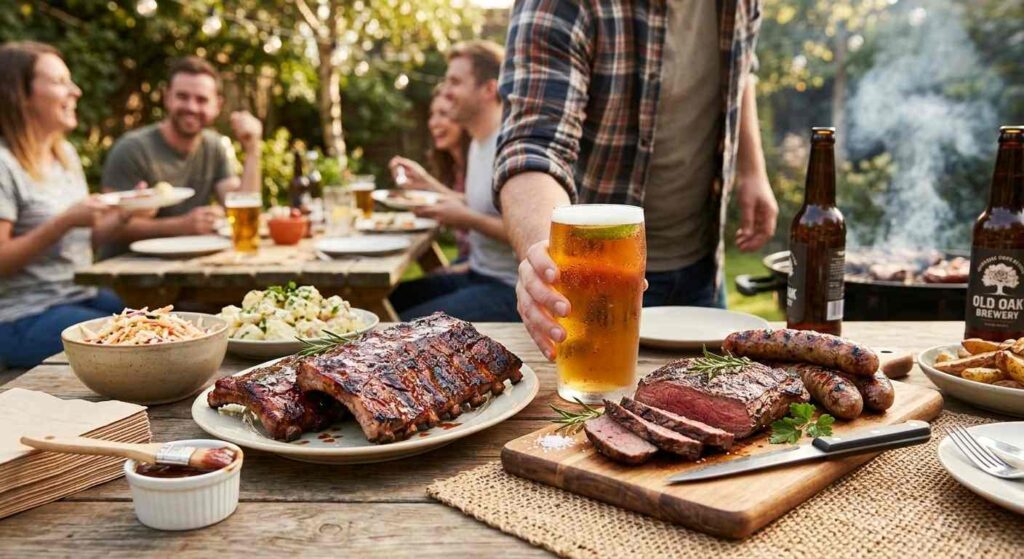
- Ancient High Priests paved the way for modern Pitmasters.
- Hardwood Smoke (Cedar & Tamarisk) laid the foundation for using Hickory & Oak.
- Sacred Barley Ales evolved into today’s Craft IPAs & Stouts.
- Temple Ceremonies served the same social purpose as a Sunday Backyard Cookout.
The Babylonians understood that food and drink are the ultimate unifying forces in human society.
Gathering around a fire, smelling meat render over hot coals, and passing around a drink isn’t just about survival. It is how we build community, celebrate life, and process our place in a crazy, unpredictable universe.
Marduk loved beer and meat for the exact same reasons we do today:
- Quality Matters: The Babylonians saved their absolute best ingredients for their highest celebrations.
- Fire Brings People Together: The scent of roasting meat was a universal signal that order had been restored and a party was starting.
- Feasting Creates Connection: Sharing a meal – whether with neighbors, kings, or the supreme ruler of the cosmos – transforms ordinary food into something truly sacred.
The Divine Hangover: Medicine, Magic, and Curing the God’s Excess
When a supreme god drinks gallons of heavy barley ale every single day, divine consequences follow. Mesopotamian physicians (asū) and exorcists (āšipu) worked closely with temple kitchens to prepare special herbal tonics for Marduk’s ritual cleanses.
- The Remedy: Cuneiform tablets show heavy indulgence was treated with a blend of licorice root, crushed mint, river rushes, and warm goat’s milk.
- The Administration: Priests offered these liquid remedies directly to the cult statue during morning purification rites.
- The Cosmic Stakes: This wasn’t just ancient medicine – it was spiritual maintenance. Restoring Marduk’s digestive balance prevented him from unleashing thunderbolts or destructive desert winds over an unsettled stomach.
The Sacred Smoke: Frankincense, Fat, and the Aromatherapy of Altars
Taste was only half the equation inside the Esagila; smell carried the divine essence. The Babylonians believed the olfactory system was the primary pathway to the spiritual realm.
- The Ingredients: Priests tossed frankincense, myrrh, and sweet cane onto bronze censers while meat rendered over burning cedar coals.
- The Sacred Vapor: This mix of sizzling fat and tree sap created sacred barbecue incense (qutrīnu) designed to soothe Marduk’s volatile temper.
- The Consequence: If this scented cloud was missing, the god would turn away, rendering all beer, bread, and roasted meat offerings completely useless.
Royal Food Tasters: Protecting the King of the Gods from Poison
Ruling an empire meant constantly dodging political assassination, and even a golden statue wasn’t exempt from paranoia. High priests implemented strict culinary security protocols for every dish served to Marduk.
- The Lineup: Dedicated temple officers – including official food tasters and royal cupbearers (sāqū) – sampled every prime rib and jar of ale before it entered the inner sanctum.
- The Code: Tasters lived under strict religious purity laws and swore absolute loyalty to the crown.
- The Crime: Poisoning a deity’s meal was the ultimate act of high treason, believed to curse an culprit’s entire bloodline.

The Divine Butcher’s Guild: Ritual Precision and Anvil-Forged Blades
Preparing meat for a cosmic ruler required far more than basic knife skills; it demanded sacred butchery practices.
- The Guild: Temple butchers (tābiḫu) formed an elite, hereditary guild bound by strict religious oaths.
- The Livestock Standards: Every animal picked for Marduk’s roasting hearths had to be physically flawless, with zero blemishes, scars, or disease.
- The Tools & Technique: Slaughtering required purified copper or bronze blades and was executed along precise joint lines to minimize animal distress. A messy cut instantly turned a holy meat sacrifice into an offensive insult.
Taboo Meats: What Babylon’s Chief God Strictly Forbidden
While Marduk’s appetite for beef and mutton was legendary, certain animals were strictly banned from entering the temple gates.
- Pork: Absolute culinary poison inside the Esagila, as swine were linked to underworld demons and filth.
- Blacklisted Foods: Bottom-feeding fish, scavenger birds, and sickly livestock were completely barred from divine menus.
- The Enforcers: Temple inspectors guarded kitchen entrances day and night, ensuring only clean, grain-fed, and religiously approved animals reached Babylon’s exclusive smoking pits.
The next time you fire up the smoker, throw on a rack of ribs, and pop the cap off a cold craft beer, remember that you aren’t doing anything new. You are carrying on a four-thousand-year-old tradition started in the ancient brick city of Babylon.
Raise a glass to old Marduk. He may have been an ancient cosmic dragon-slayer, but when it came to a weekend feast, the guy had absolute top-tier taste.
Frequently Asked Questions (FAQ)
Q: Who was Marduk and why was he so important to ancient Babylon?
A: Marduk was the chief deity of ancient Babylon. Originally a local farm god, he rose to supreme ruler of the Mesopotamian pantheon after defeating the chaos dragon Tiamat in the epic myth Enuma Elish. Babylonians believed humanity was created specifically to serve Marduk and keep his temple supplied with food and drink.
Q: Did the Babylonians actually believe a golden statue was eating meat and drinking beer?
A: Not physically. The Babylonians believed Marduk’s spiritual essence inhabited the cult statue. During meals, priests pulled a heavy linen curtain to give the god privacy while he invisibly absorbed the aroma, soul, and flavor profile of the offerings.
Q: What happened to all the meat and beer after the god “consumed” it?
A: Nothing went to waste. Once Marduk absorbed the food’s spiritual essence, the physical leftovers – called remaut – were considered blessed. They were served to the King of Babylon, high-ranking temple priests, cooks, and visiting foreign dignitaries.
Q: What kind of beer did ancient Babylonians brew for Marduk?
A: Mesopotamian beer (sikaru) was thick, hazy, and rich in nutrients, often consumed through reed straws to filter out floating grain husks. Temple brewers crafted several varieties for Marduk, including Red Beer (Sikaru Huššû), sweet dark stouts, and fine filtered ales.
Q: Why was meat such a big deal in offerings to Marduk?
A: For ordinary Babylonians, meat was a rare luxury saved for major holidays. Serving prime cuts – like fattened bull shoulders, prime ribs, and whole roasted rams – to Marduk every day was the ultimate display of wealth, reverence, and devotion to keep the god happy.
Q: What foods were strictly forbidden from Marduk’s altar?
A: Pork was completely blacklisted inside the Esagila temple complex due to its association with filth and underworld demons. Bottom-feeding fish, scavenger birds, and any diseased or blemished livestock were also strictly banned from Marduk’s smoking pits.
Q: What was the Akitu Festival?
A: The Akitu Festival was Babylon’s 12-day New Year celebration held every spring. It featured mass livestock slaughters, public feasts, and thousands of gallons of free beer funded by the king to celebrate Marduk’s rule and ensure prosperity for the empire.
Featured image credit: @ancientknowledge_
