
How do you keep a knife sharp enough to glide through a ripe tomato without crushing it, slice brisket without tearing the bark, or break down meat without fighting the blade?
The secret isn’t necessarily buying the most expensive knife in the shop. It’s knowing how to maintain the edge you already have.
Even the finest chef’s knife eventually loses its bite. Daily chopping, slicing, trimming, and contact with cutting boards gradually wear down its cutting edge. Before long, that once-beautiful blade starts behaving like a butter knife at a barbecue competition.
Nobody wants that kind of disappointment when dinner is on the line.
The good news? You don’t need a professional sharpening workshop to keep your knives performing at their best. The right knife sharpening tools and strops can restore dull edges, refine cutting performance, and help extend the life of your favorite blades.
From traditional whetstones and diamond sharpening plates to leather strops and polishing compounds, each tool serves a different purpose. Some remove metal to create a fresh cutting edge, others maintain its alignment, while finishing tools polish the bevel for improved sharpness.
Let’s explore 10 essential sharpening tools and strops that deserve a place in your knife maintenance arsenal.
1. Whetstones
Best for: Precise sharpening and complete edge restoration.
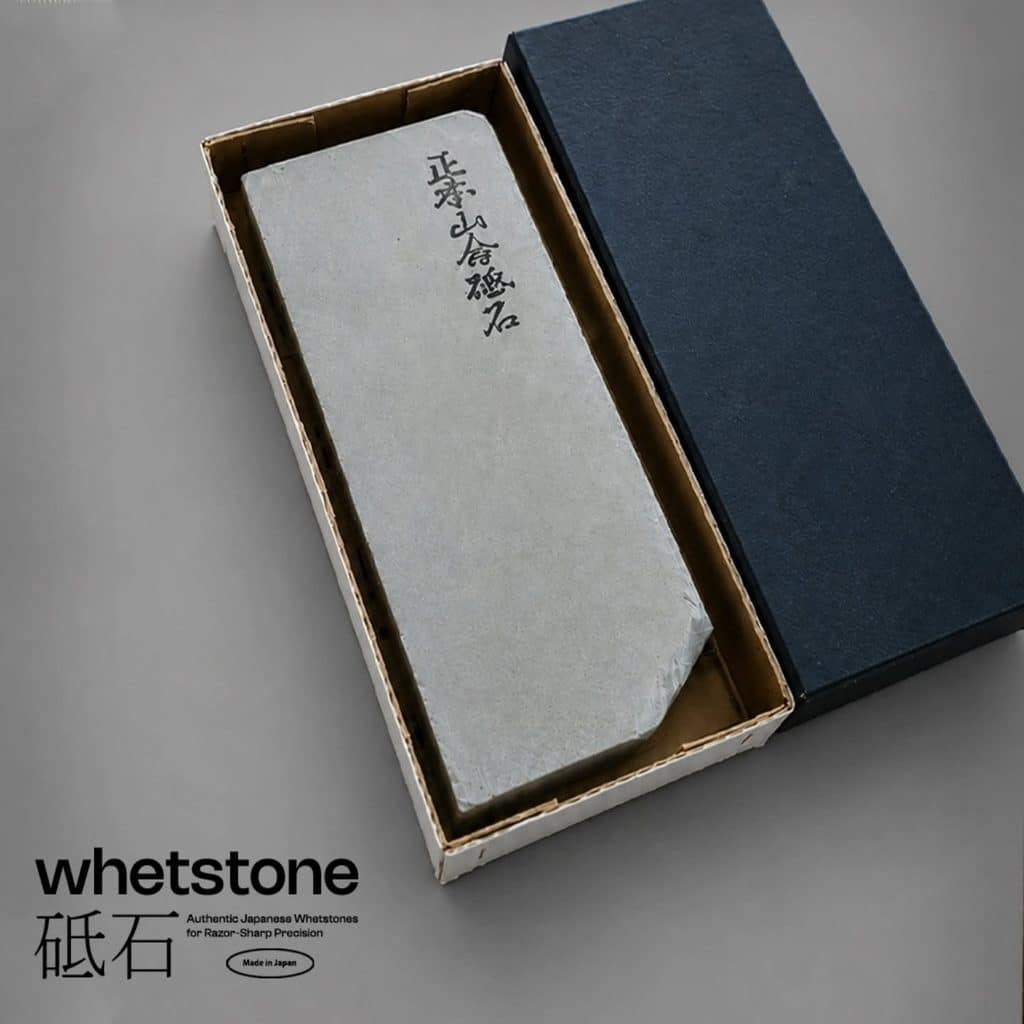
Whetstones are the traditional workhorses of knife sharpening, and professional cooks have relied on them for generations. These abrasive stones remove small amounts of metal to create a fresh, sharp cutting edge.
They’re available in different grit ratings, each designed for a specific sharpening stage:
- Coarse grit (200–600): Repairs damaged edges and reshapes severely dull blades.
- Medium grit (800–2,000): Establishes and refines the cutting edge.
- Fine grit (3,000–8,000): Polishes and refines an already sharp edge.
Whetstones require some practice, especially when maintaining a consistent sharpening angle. However, once you develop the technique, they offer excellent control over the final result.
For anyone serious about knife maintenance, a quality whetstone is among the most versatile knife sharpening tools available. Just check whether your stone requires soaking or simply a little water on its surface. Not every whetstone enjoys taking a bath.
2. Diamond Sharpening Stones
Best for: Fast sharpening, hard steel, and damaged edges.
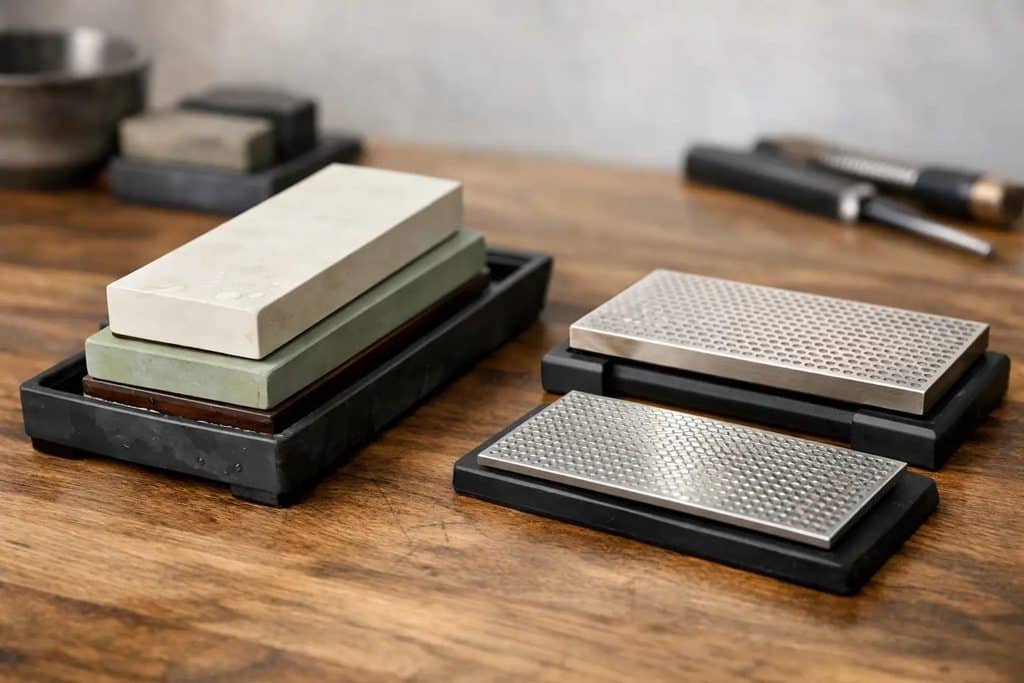
Diamond sharpening stones bring serious cutting power to the sharpening bench. Their surfaces contain industrial diamond abrasives bonded to a metal plate, allowing them to remove steel efficiently.
They’re particularly useful for harder knife steels that can take considerably longer to sharpen using conventional stones.
Here are some reasons they’re worth considering:
- Fast metal removal: Useful for restoring badly dulled edges.
- Excellent durability: Diamond abrasives maintain their cutting ability over extended use.
- Versatile grit options: Available in coarse, medium, and fine grades.
Another advantage is that quality diamond plates generally maintain their flat surfaces, unlike traditional whetstones that may require occasional flattening.
However, diamond abrasives can be aggressive. Applying excessive pressure or choosing an unnecessarily coarse plate can remove more metal than needed.
They’re excellent for serious sharpening work, but don’t treat them like power tools. A light, controlled touch usually produces better results.
3. Ceramic Sharpening Rods
Best for: Routine edge maintenance and light sharpening.
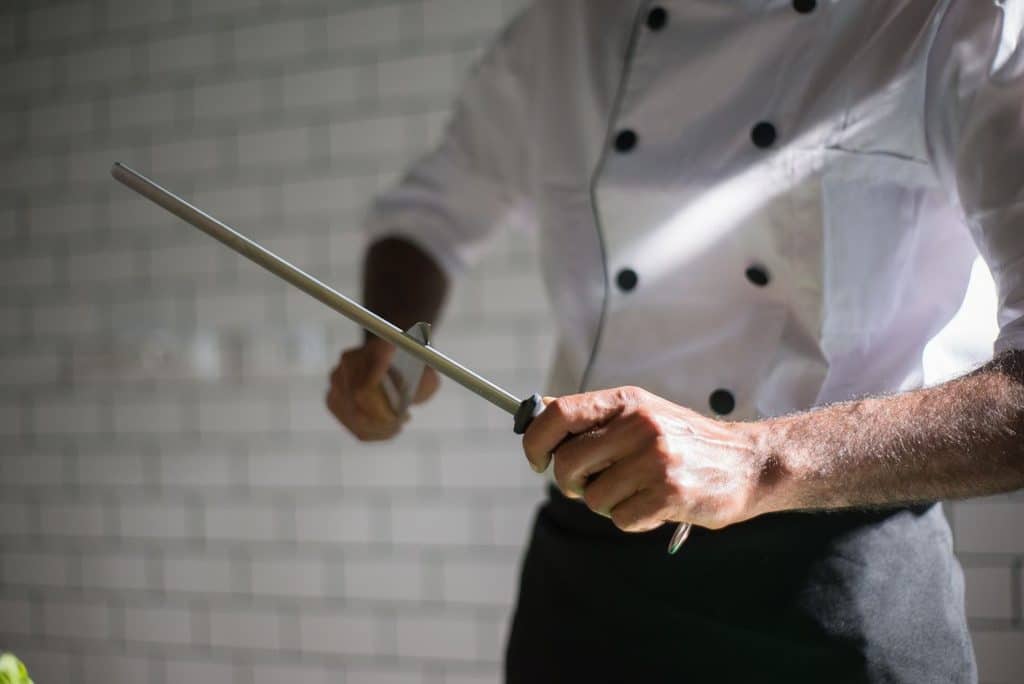
Ceramic sharpening rods are convenient tools for maintaining kitchen knives between full sharpening sessions. Unlike traditional smooth honing steels, ceramic rods contain fine abrasive material that removes small amounts of metal while refining the cutting edge.
Think of them as a practical middle ground between conventional honing and full sharpening.
Ceramic rods work particularly well for frequently used kitchen knives that have started losing their cutting performance but aren’t severely dull.
Their advantages include:
- Fine edge refinement: Helps restore cutting performance between sharpening sessions.
- Compact design: Easy to store and convenient to use.
- Controlled abrasion: Removes relatively little metal when used correctly.
For best results, hold the knife at its recommended sharpening angle and use light, controlled strokes.
One important reminder: ceramic is hard but brittle. Dropping a sharpening rod onto a tiled kitchen floor can turn your investment into an expensive collection of ceramic pieces.
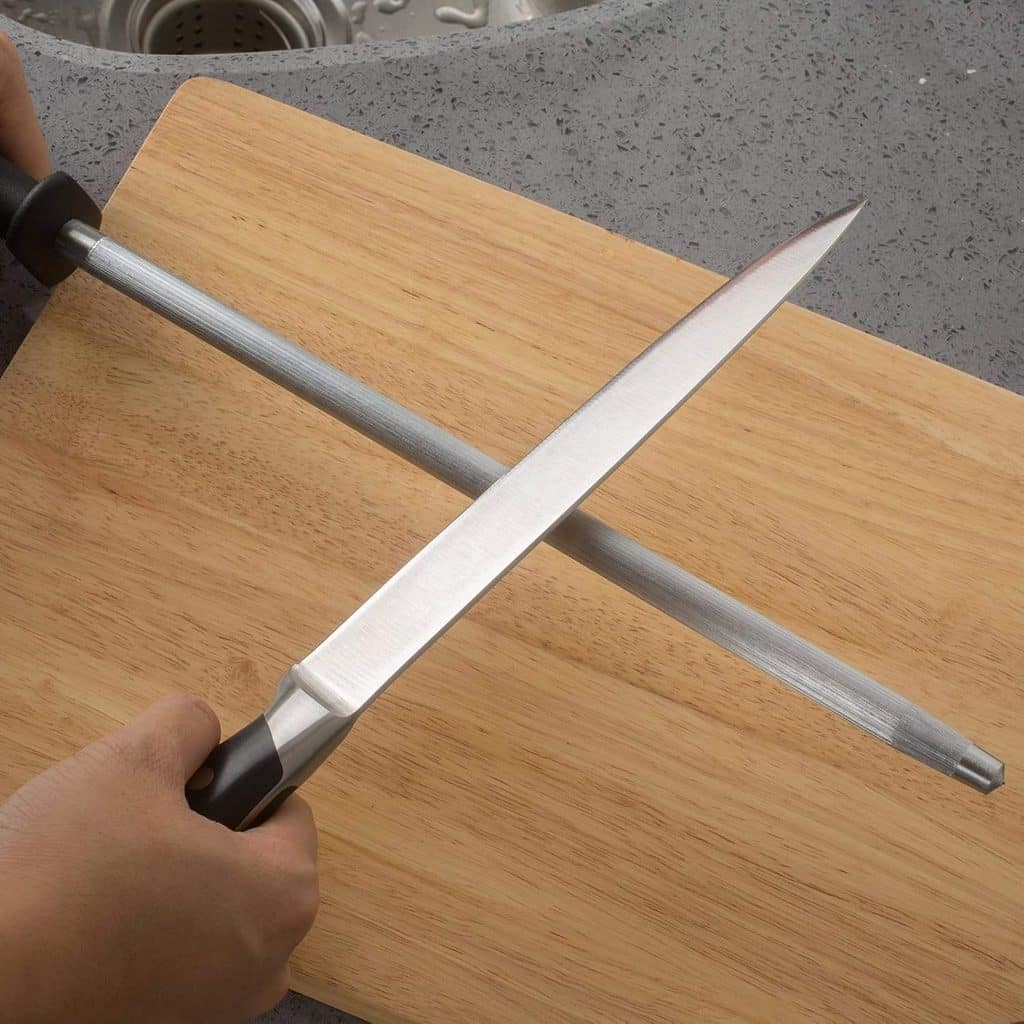
4. Honing Steel Rods
Best for: Realigning slightly rolled knife edges.
A honing steel is one of those kitchen tools that looks intimidating but becomes surprisingly simple once you understand its purpose.
Despite its name, a traditional smooth honing rod doesn’t significantly sharpen a blade by removing metal. Instead, it helps realign a slightly rolled cutting edge, restoring some of its cutting performance.
This makes it particularly useful for frequently used kitchen knives that gradually lose their bite during everyday food preparation.
Common options include:
- Smooth steel rods: Primarily help realign slightly rolled edges.
- Ribbed steel rods: Offer a more aggressive contact surface.
- Ceramic rods: Combine honing with light abrasive sharpening.
For cooks who regularly trim brisket, break down meat, or prepare mountains of vegetables, a honing rod is a convenient maintenance companion.
Just remember that honing isn’t the same as sharpening. A severely dull knife needs actual sharpening, not another few dramatic swipes against a steel rod. Your blade deserves better than false confidence.
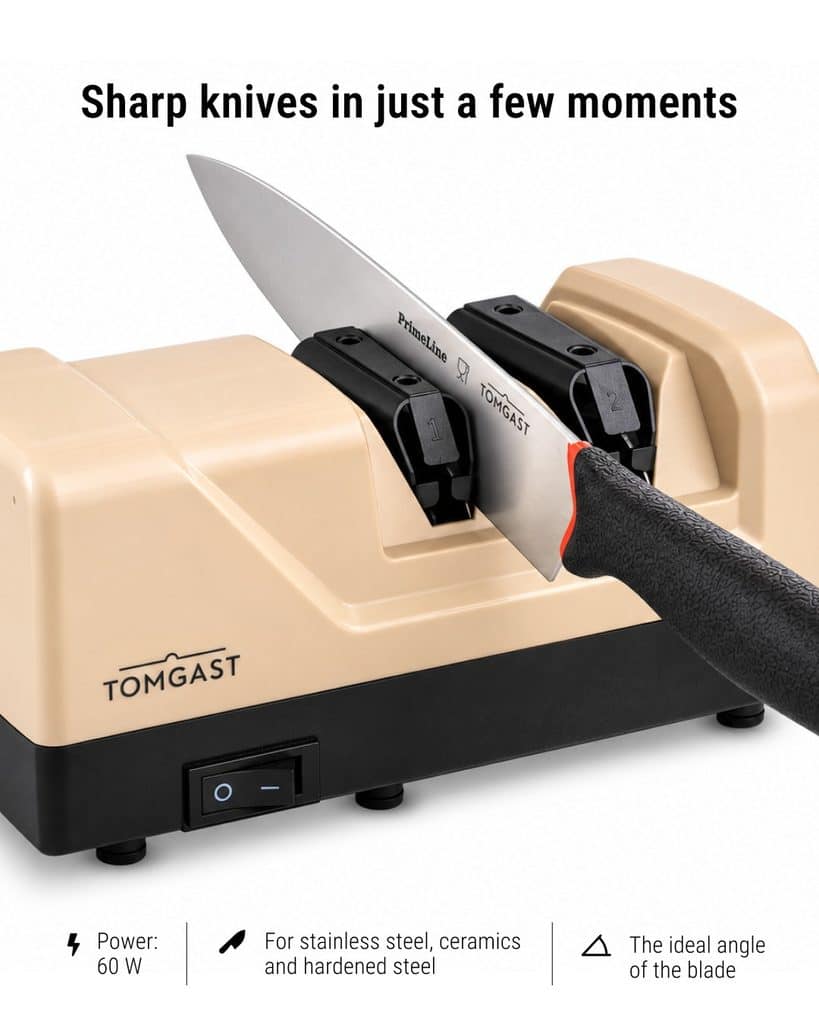
5. Electric Knife Sharpeners
Best for: Convenience and consistent sharpening at home.
Not everyone wants to spend an afternoon mastering freehand sharpening techniques. That’s where electric knife sharpeners come in.
These countertop machines use motor-driven abrasive wheels or belts to sharpen blades through guided slots. Many feature multiple stages for initial sharpening, edge refinement, and polishing.
Their biggest advantage is convenience. Follow the manufacturer’s instructions, use the appropriate sharpening stage, and let the machine handle much of the work.
Look for features such as:
- Multiple sharpening stages: Handle sharpening, refining, and finishing.
- Angle guides: Help maintain consistent bevel geometry.
- Fine finishing abrasives: Improve the final edge quality.
Electric sharpeners are particularly useful in busy home kitchens where several knives need regular attention.
However, not every model suits every blade. Some are designed specifically for Western-style kitchen knives and may damage delicate Japanese knives or specialized single-bevel blades.
Choose a machine compatible with your knives. Repeatedly sharpening a blade that only needs light maintenance can unnecessarily shorten its lifespan.
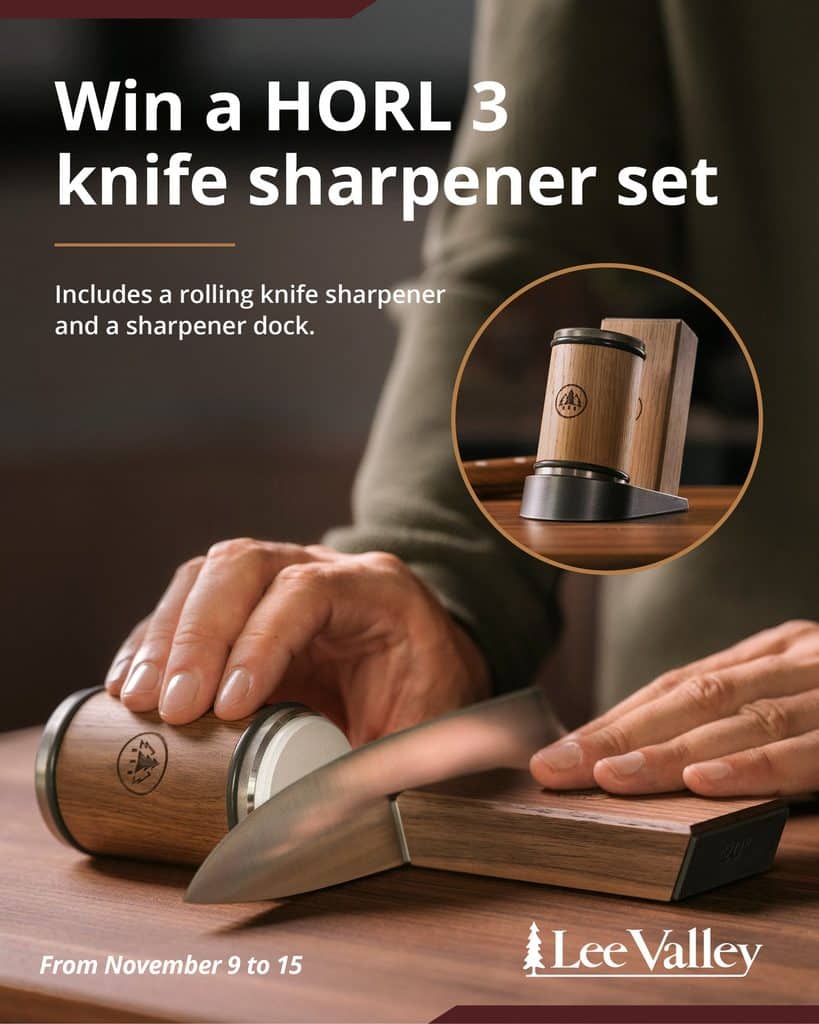
6. Manual Pull-Through Sharpeners
Best for: Quick sharpening and beginner-friendly maintenance.
Manual pull-through sharpeners are the grab-and-go option of the sharpening world. They’re compact, relatively affordable, and designed to make basic sharpening accessible without requiring much technical knowledge.
Most models feature preset sharpening slots containing carbide, ceramic, or diamond abrasives.
Typically, the carbide stage removes metal to establish a fresh edge, while the ceramic stage refines the cutting surface.
Their main advantages include:
- Easy operation for beginners.
- Compact designs for small kitchens.
- No electricity or complicated setup required.
- Convenient maintenance for compatible knives.
However, convenience comes with limitations. Fixed sharpening angles may not match the original bevel of every knife, and aggressive carbide inserts can remove excessive metal.
For inexpensive everyday kitchen knives, a quality pull-through sharpener can be practical. For premium Japanese knives, delicate blades, or specialized cutting tools, a whetstone or guided sharpening system offers better control.
Think of pull-through sharpeners as a quick pit stop rather than a complete performance upgrade.
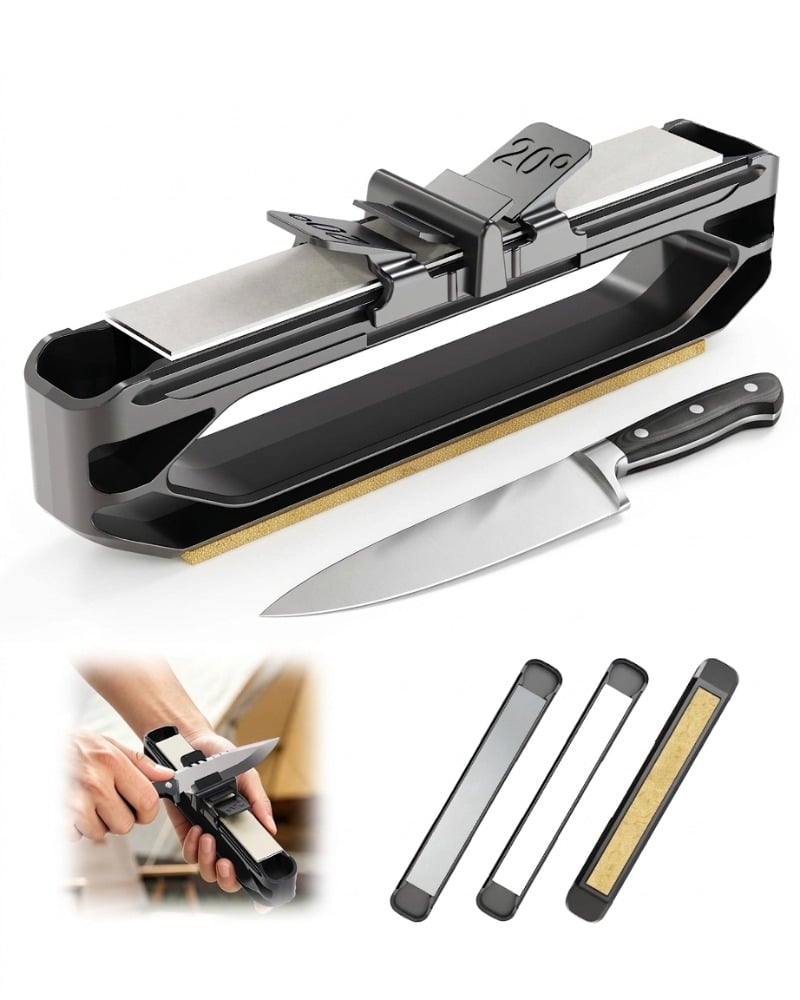
7. Guided-Angle Sharpening Systems
Best for: Precision sharpening and repeatable results.
Maintaining a consistent sharpening angle is one of the biggest challenges when using traditional whetstones. Even a slight change in angle can affect the bevel and make it difficult to achieve a uniform cutting edge.
Guided-angle sharpening systems help solve that problem.
These setups secure the knife in a clamp or positioning mechanism while holding the sharpening abrasive at a controlled angle. Many models feature adjustable settings, interchangeable stones, and different abrasive grades.
Why are they worth considering?
- Consistent sharpening angles: Help maintain uniform bevel geometry.
- Greater control: Make detailed sharpening easier.
- Customizable finishes: Allow users to progress through different abrasive grits.
- Repeatable results: Make it easier to reproduce a preferred edge.
They’re particularly useful for enthusiasts who maintain expensive kitchen knives, hunting knives, and other precision blades.
The downside is that guided systems can cost more and require additional setup compared with a simple whetstone.
Still, for anyone who wants consistent results without relying entirely on freehand technique, they’re an excellent investment.
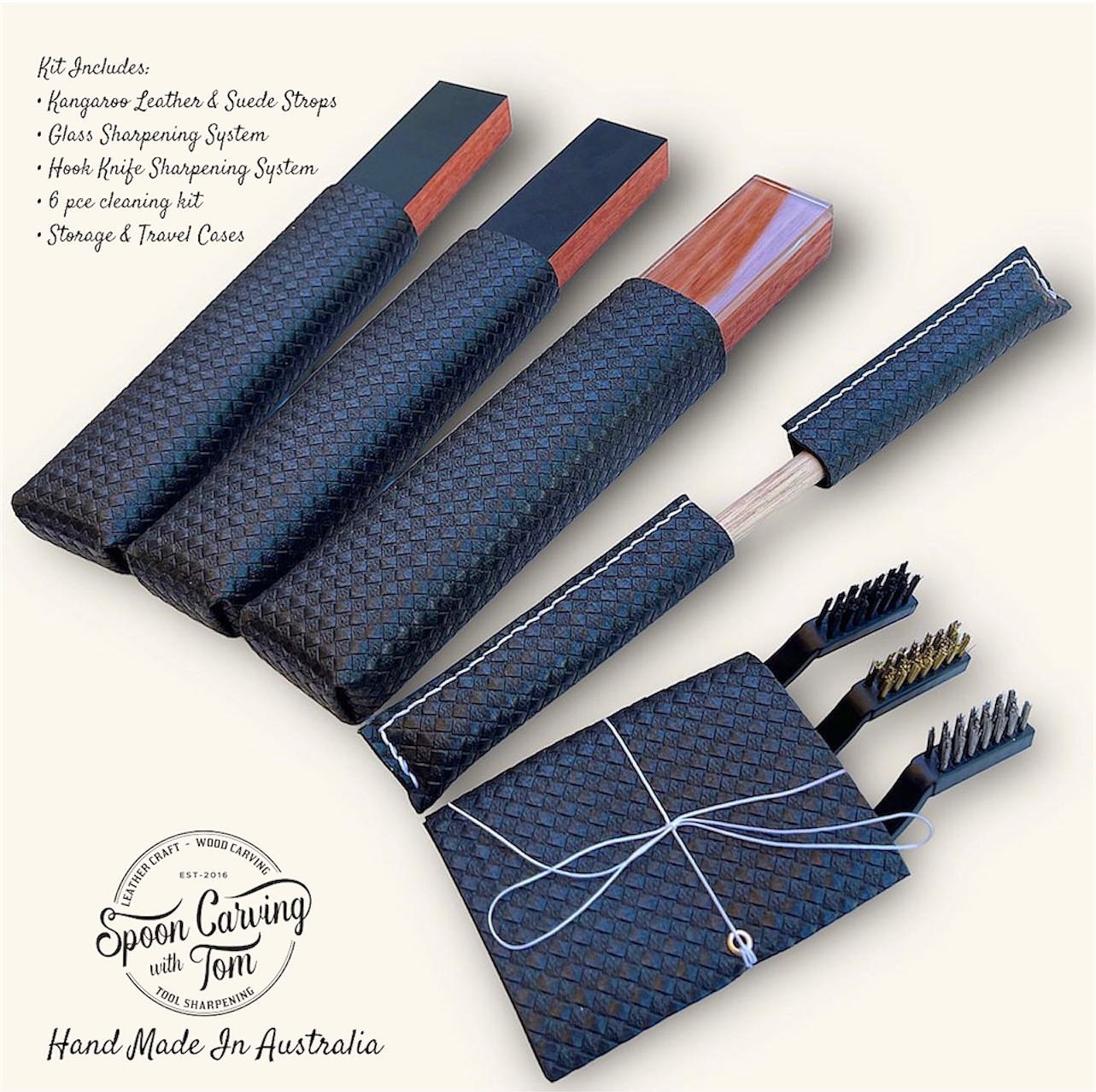
8. Leather Stropping Paddles
Best for: Final edge refinement and polishing.
Now we’re getting into the finishing touches.
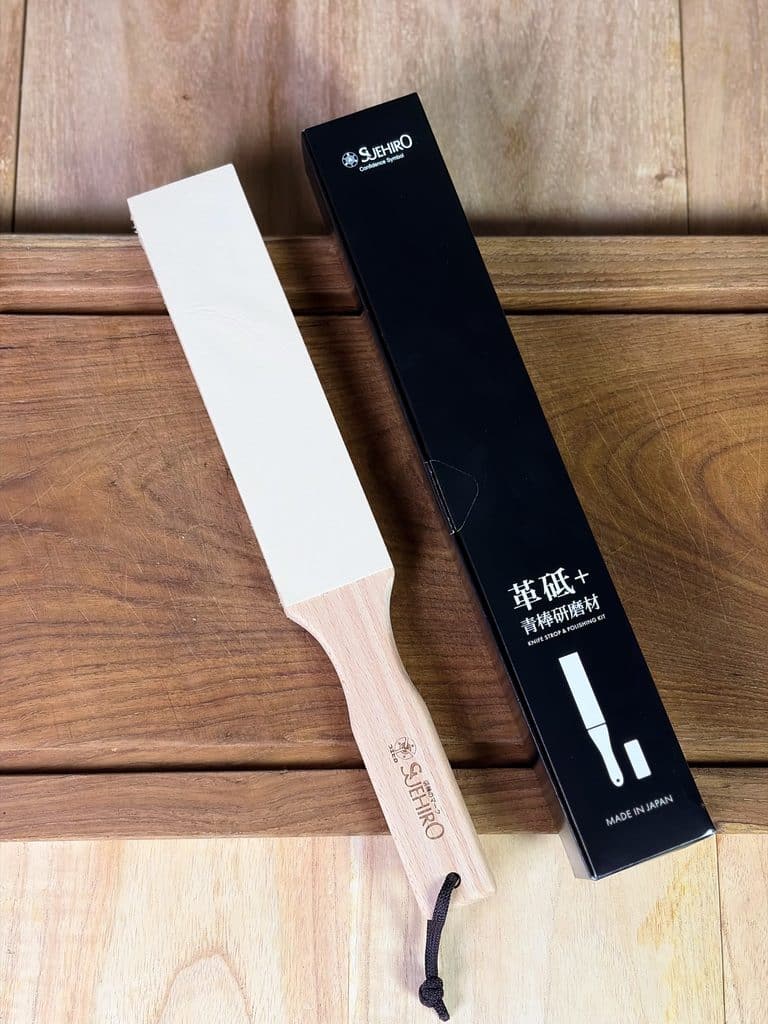
Leather stropping paddles are designed to refine an already sharpened knife edge. Rather than aggressively removing metal, stropping helps polish the bevel and remove or reduce the tiny burr left behind during sharpening.
Most paddles feature a flat piece of leather attached to a wooden or rigid backing. Some have smooth leather on one side and a slightly textured surface on the other. Polishing compounds can also be applied to increase the strop’s abrasive action.
Their benefits include:
- Edge refinement: Helps produce a cleaner, more polished cutting edge.
- Burr removal: Helps remove small remnants of the sharpening burr.
- Convenience: Easy to use and store.
- Versatility: Suitable for many kitchen, outdoor, and utility knives.
Technique matters. Always move the blade with its spine leading and cutting edge trailing, keeping the bevel flat against the leather.
A few light, controlled passes can make a noticeable difference. Press too hard, however, and you risk rounding the apex. That’s the opposite of what we’re trying to achieve.
9. Hanging Leather Strops
Best for: Flexible stropping and traditional razor-edge maintenance.
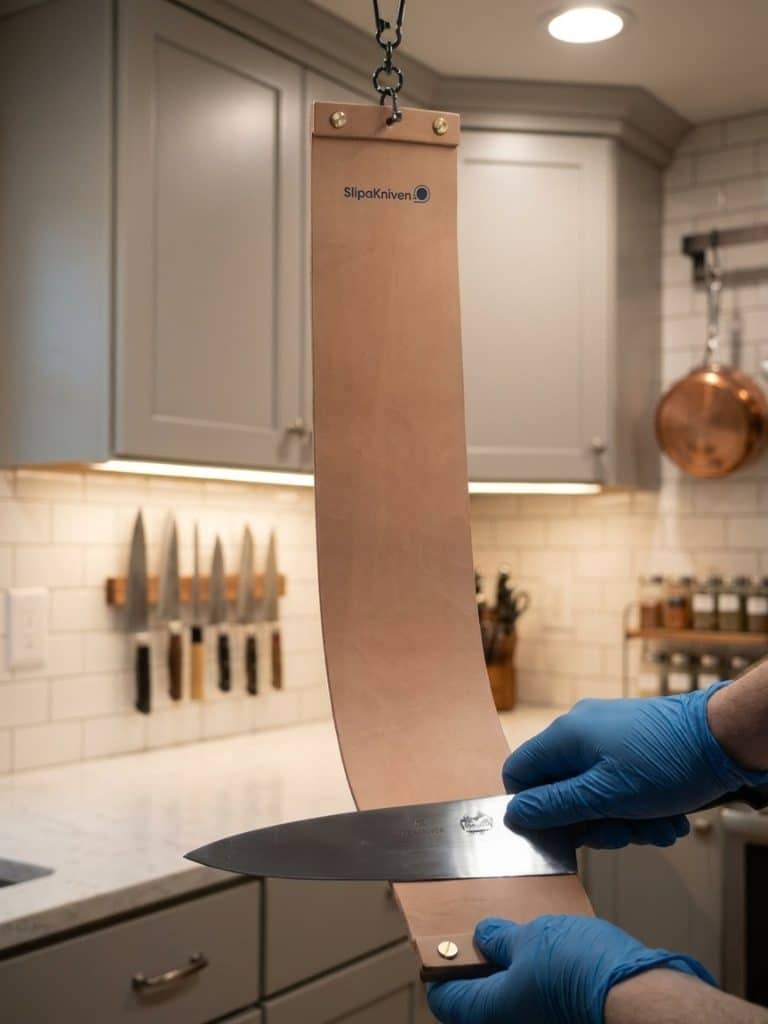
Hanging leather strops are particularly popular among straight-razor enthusiasts, barbers, and people who appreciate traditional blade maintenance.
Unlike rigid paddle strops, these feature a long strip of leather suspended between a handle and an attachment point. The leather can be tensioned during use, creating a flexible stropping surface.
Their main advantage is the ability to work across a longer surface, making them useful for polishing straight razors and compatible knife blades.
Some key characteristics include:
- Flexible leather surface: Provides a traditional stropping experience.
- Long working area: Accommodates longer blades.
- Compound compatibility: Works with suitable polishing abrasives.
- Portable design: Easy to store and transport.
Hanging strops require more technique because the leather can flex under pressure. For knives, use controlled movements and maintain the correct contact angle. Avoid excessive pressure, which can cause the leather to deform around the blade and round the cutting edge.
They’re not essential for every kitchen, but they’re a worthwhile option for enthusiasts who enjoy traditional edge finishing.
10. Stropping Compounds and Polishing Pastes
Best for: Fine polishing and achieving a refined cutting edge.
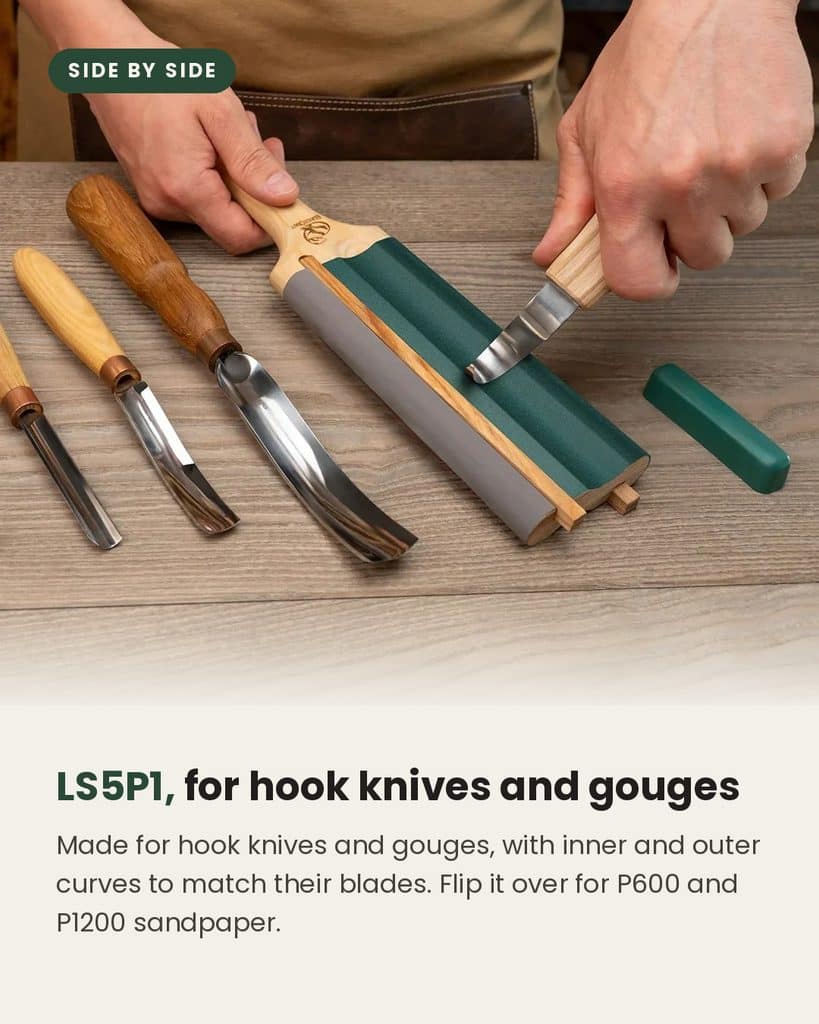
A leather strop works perfectly well on its own, but adding the right polishing compound can take edge refinement further.
Stropping compounds contain fine abrasive particles that polish the bevel and help remove microscopic imperfections. They’re available in different abrasive materials and particle sizes.
Popular options include:
- Chromium oxide: A traditional green polishing compound commonly used for fine edge refinement.
- Diamond compound: Available in extremely fine abrasive grades for precise polishing.
- Aluminum oxide: A versatile abrasive used in sharpening and polishing applications.
Generally, finer abrasives are more suitable for finishing an already sharp edge.
However, finer isn’t automatically better. A highly polished edge isn’t necessarily the best performer for every cutting task. Some knives benefit from retaining a little toothiness, particularly when slicing tomatoes, cutting rope, or working with meat.
Match the compound to your intended finish, and remember that a little goes a long way.
How to Choose the Right Knife Sharpening Tool
Choosing among different knife sharpening tools and strops depends on your knives, sharpening experience, and maintenance routine.
Start by considering these factors:
- Knife steel: Harder steels may benefit from diamond abrasives, while conventional kitchen knives work well with quality whetstones.
- Blade condition: Coarse abrasives repair damaged or dull edges, while fine stones refine sharper ones.
- Sharpening experience: Beginners may prefer guided systems or quality manual sharpeners.
- Desired finish: Leather strops and polishing compounds help refine an established edge.
- Maintenance routine: Frequent cooks benefit from having a honing rod or ceramic rod readily available.
For a versatile setup, consider a medium-grit whetstone, a fine finishing stone, a ceramic honing rod, and a leather strop.
You don’t need every sharpening gadget available. Choose tools that complement one another and suit the knives you actually use.
Tips for Maintaining a Scalpel-Like Knife Edge
A sharp knife requires consistent care, not constant sharpening.
Follow these simple maintenance habits:
- Use the correct sharpening angle for your blade.
- Apply light, controlled pressure when sharpening and stropping.
- Clean and dry knives after every use.
- Avoid cutting directly on glass, stone, or ceramic surfaces.
- Store knives in protective sheaths, blocks, or magnetic racks.
- Use honing and stropping between sharpening sessions when appropriate.
Most importantly, don’t wait until your knife struggles to cut before giving its edge some attention.
Final Thoughts
Keeping your knives razor-sharp isn’t just about having the right equipment; it’s about developing good maintenance habits. The right knife sharpening tools and strops help restore dull edges, refine cutting performance, and extend the life of your favorite blades.
Whether you prefer traditional whetstones, modern sharpening systems, or leather strops, consistency makes all the difference. Invest in quality tools, practice proper sharpening techniques, and give your blades the attention they deserve.
After all, a sharp knife makes every kitchen task easier, safer, and more enjoyable.
Featured image credit: @spoon_carving_with_tom
