
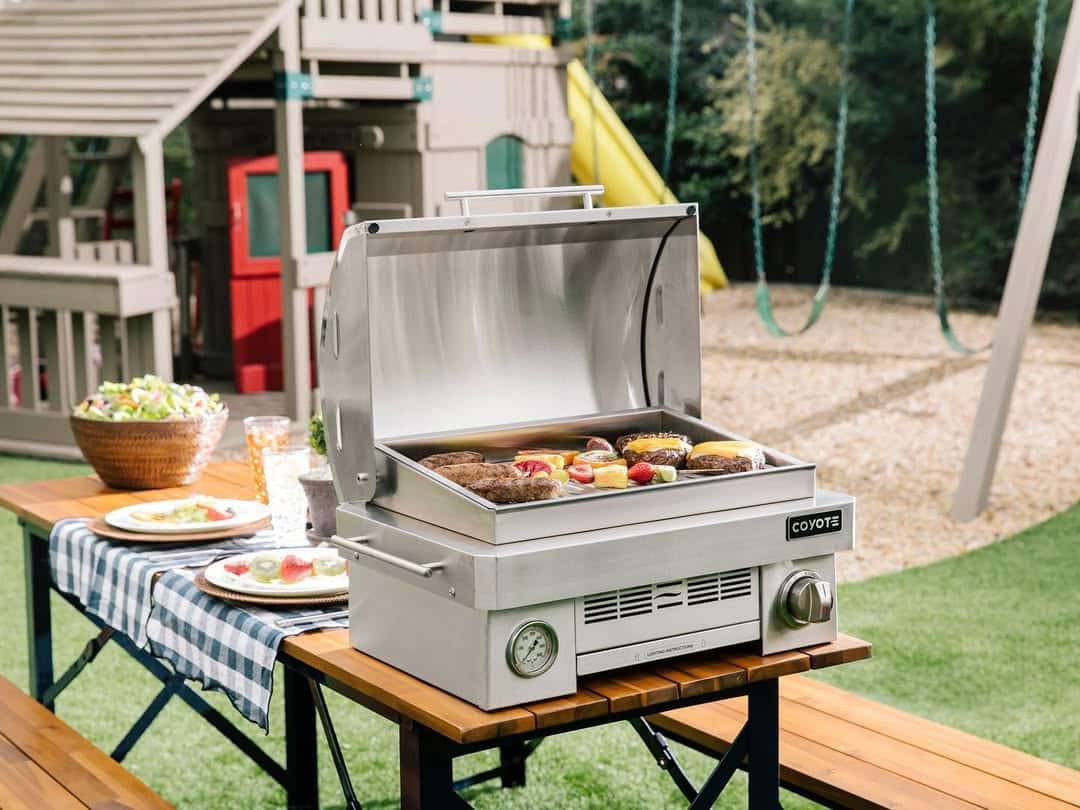
Imagine the cold sweat that breaks out when the spatula hits the metal and you realize you’re out of real estate.
It’s that moment when you’re standing in a park or a stadium parking lot, spatula in hand, and you realize your “portable” grill can only fit three burger patties at a time – but there are twelve hungry people staring at you like you’re the only thing standing between them and total starvation.
For years, the market for portable gas grills was defined by a frustrating trade-off: you could have a grill that was easy to carry, or you could have a grill that actually cooked enough food to feed a family.
If you wanted both, you usually ended up with a rusted drum grill that leaked grease into your trunk or a tabletop unit so flimsy it felt like a stiff breeze might send your dinner into the neighbor’s yard.
But times have changed. We are living in a golden age of outdoor engineering.
Today, “portable” doesn’t have to mean “puny.” Whether you’re a seasoned pitmaster or someone who just enjoys the sound of a sear, you can now find high-capacity rigs that offer the surface area of a mid-sized backyard grill with the soul of a traveler.
This guide is about those heavy hitters – the grills that let you host a serious cookout without needing a flatbed trailer.
What Makes a Portable Grill “High Capacity”?
Before we dive into the hardware, let’s talk shop. If you’re used to a massive four-burner setup at home, a portable unit is always going to feel a bit like cooking in a New York City apartment kitchen.
However, “high capacity” in the portable world is defined by a few specific metrics that separate the toys from the tools.
Cooking Surface Area is your primary currency. Most standard portable units offer around 140 to 180 square inches. That’s fine for a lonely hot dog, but for a crowd, you want to hunt for the 250 to 350 square inch range.
To put that in plain English: that’s the difference between flipping four burgers and flipping twelve.
Then there’s the Burner Configuration. A single-burner grill is a blunt instrument. It’s either on or off. High-capacity cooking for a crowd usually involves different types of food finishing at different times. Look for dual-burner systems.
They allow you to create distinct heat zones, meaning you can sear a steak on the left while toasted buns stay warm on the right without turning into charcoal briquettes.
Finally, consider Thermal Recovery. When you have a grill packed edge-to-edge with cold meat, the temperature inside the dome plummets.
A high-capacity grill needs enough BTU (British Thermal Unit) “oomph” to bounce back quickly every time you open the lid to check the progress.
If the grill takes ten minutes to get back up to temperature, you aren’t grilling; you’re just warming meat up in a humid metal box.
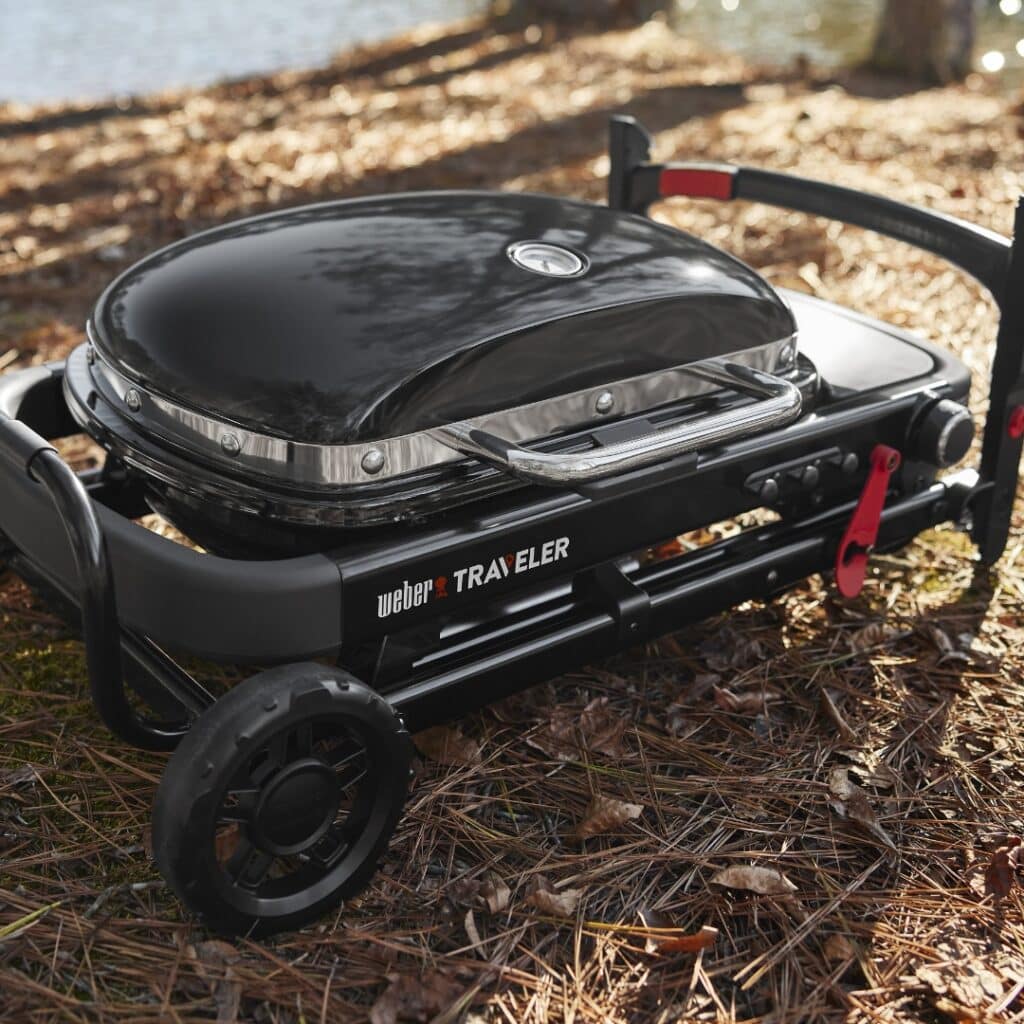
1. The Weber Traveler: The King of the Fold
If I had to describe the Weber Traveler in one sentence, it’s the grill for people who want the performance of a suburban backyard but only have the trunk space of a hatchback.
Weber took their decades of porcelain-enamel expertise and mounted it onto a sturdy, integrated scissor-cart.
The “Crowd-Pleaser” Feature: The sheer ease of use. It folds down with one hand, much like a high-end baby stroller, except instead of a crying infant, it carries 320 square inches of cooking space.
Technical Specs:
- Cooking Area: 320 sq. in.
- BTUs: 13,000
- Weight: 47 lbs
- Fuel Type: 1lb Propane Cylinder (Adapter available for 20lb tanks)
The Host’s Verdict: This is the Goldilocks of portable gas grills. It’s big enough to cook 15 burgers at once, yet it’s designed so intelligently that it won’t ruin your lower back when you’re loading it into the SUV.
It’s best for those who do a lot of “destination grilling” – think beach days or state parks where you need to trek from the parking lot to the picnic table.
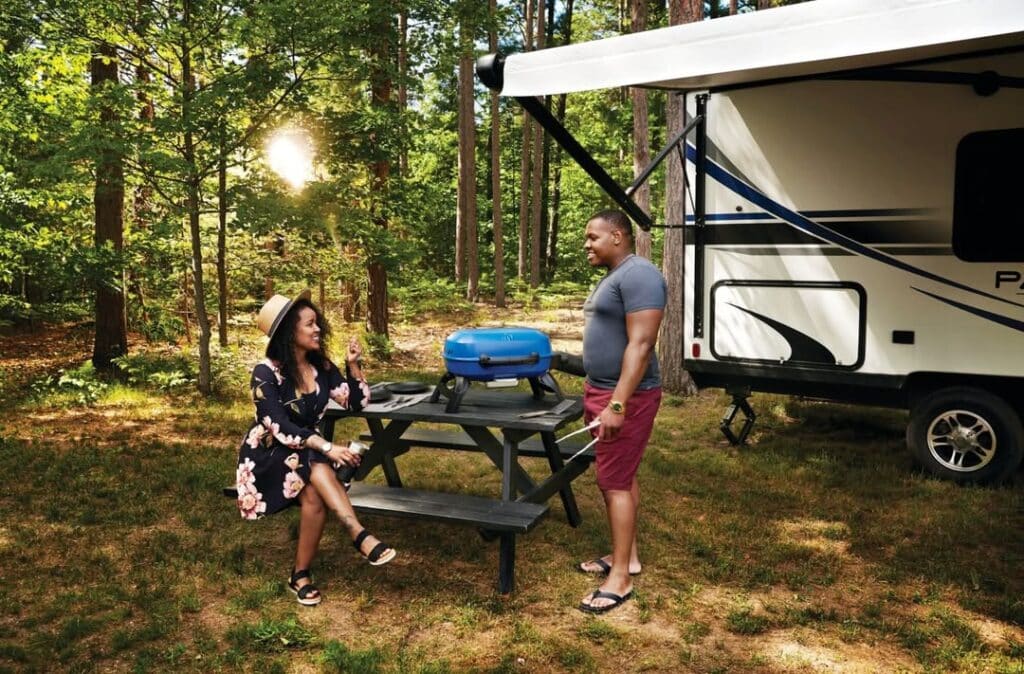
2. Napoleon TravelQ PRO285: The Powerhouse
Napoleon is often the “if you know, you know” brand of the grilling world.
Their TravelQ PRO285 doesn’t look like a traditional grill; it looks like something a futuristic soldier would use to cook rations on Mars. But under that cast-aluminum lid lies a beast.
The “Crowd-Pleaser” Feature: Dual stainless steel burners. Most portable grills in this class settle for one burner. Napoleon gives you two, which means you can actually master indirect grilling on the go.
You can roast a whole chicken on this thing if you’re feeling ambitious.
Technical Specs:
- Cooking Area: 285 sq. in.
- BTUs: 12,000
- Weight: 29 lbs (tabletop version)
- Fuel Type: Propane
The Host’s Verdict: If you are the type of cook who gets annoyed by “hot spots” and uneven cooking, this is your rig.
The iconic WAVE cooking grids give you those professional sear marks that make people think you’ve spent years in a culinary school rather than just watching YouTube tutorials.
It’s the best choice for the “chef” of the group who wants total control.
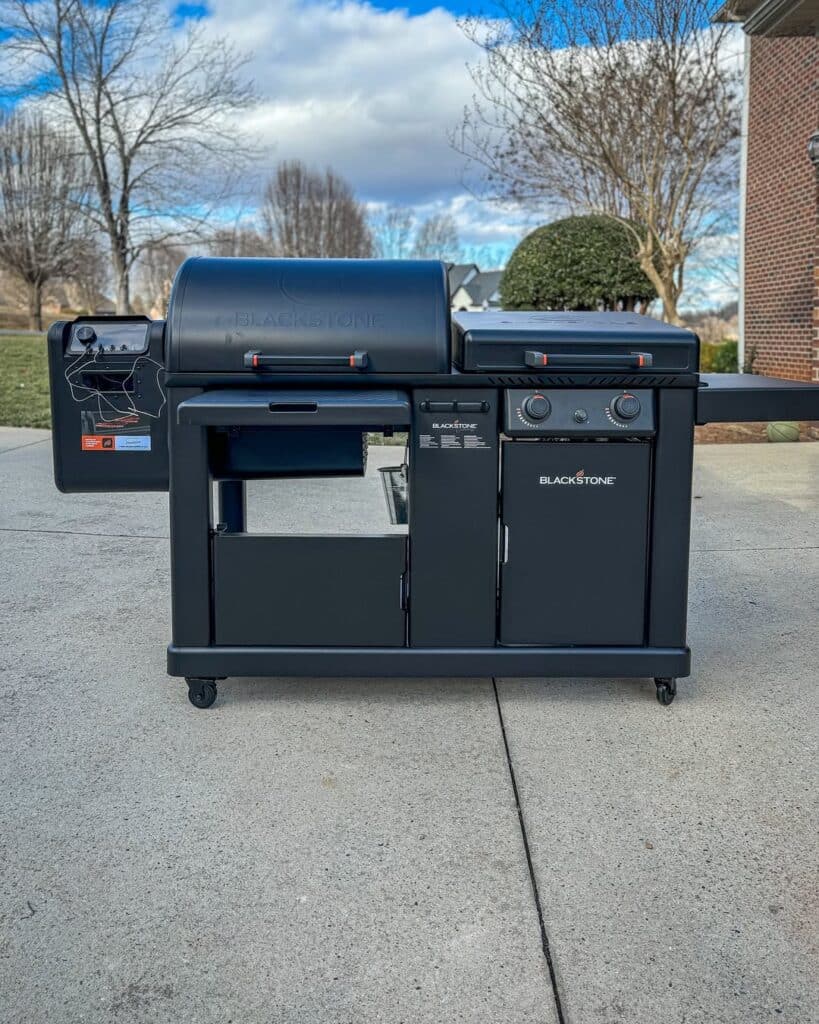
3. Blackstone 22” On-The-Go Griddle: The Crowd’s Choice
We need to address the elephant in the room: sometimes the best grill isn’t a grill at all—it’s a griddle. The Blackstone 22” has taken the outdoor world by storm because it solves the “breakfast, lunch, and dinner” problem in one go.
The “Crowd-Pleaser” Feature: The flat-top versatility. You can’t cook a pound of bacon and a dozen eggs on a traditional grate without a massive mess. On a Blackstone, you’re basically a short-order cook at a high-end diner.
Technical Specs:
- Cooking Area: 361 sq. in.
- BTUs: 24,000
- Weight: 50 lbs
- Fuel Type: Propane
The Host’s Verdict: This is for the ultimate social host. If your cookouts start at 10:00 AM with pancakes and end at 8:00 PM with smash burgers, the Blackstone is unbeatable.
The surface area is massive – easily the largest on this list – making it the undisputed heavy-weight champion for sheer volume.
Just remember: you’ll need to master the art of “seasoning” the cold-rolled steel plate, but the payoff is a non-stick surface that gets better with every burger.
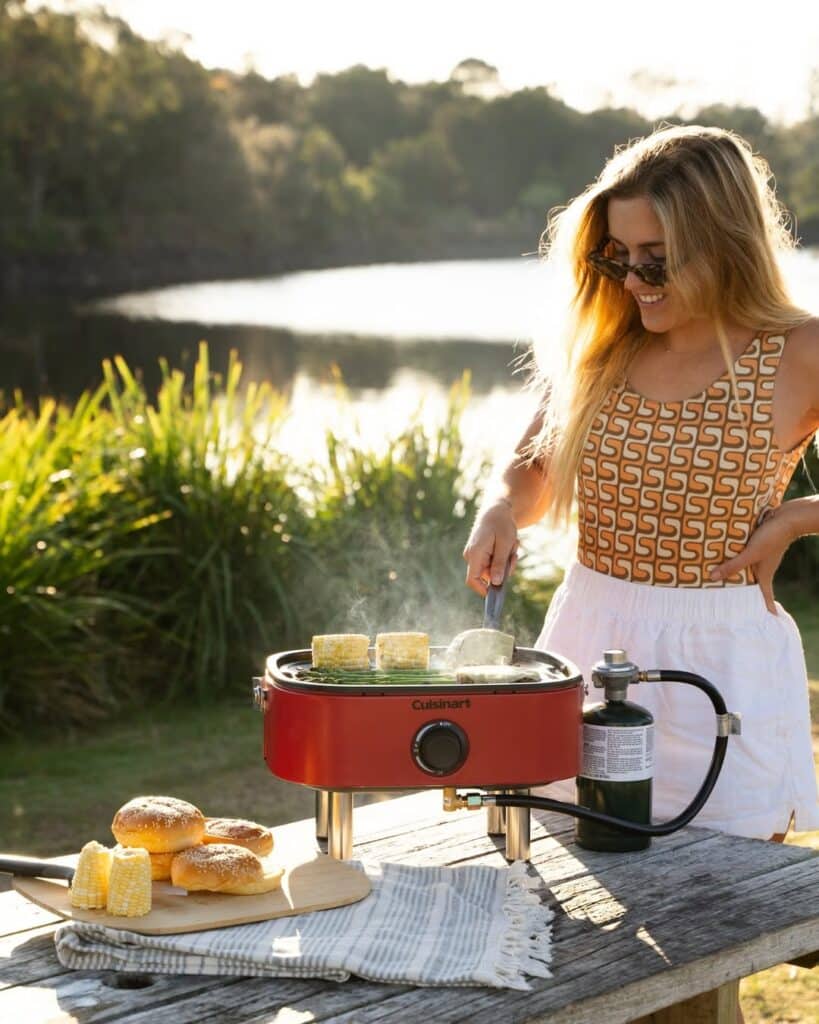
4. Cuisinart Professional Portable: The Stainless Steal
If you want your gear to look as professional as your knife roll, the Cuisinart Professional Portable is the aesthetic choice. It’s built entirely of stainless steel, giving it a sleek, “commercial kitchen” vibe that holds up incredibly well against the elements.
The “Crowd-Pleaser” Feature: Two independent burners with dedicated electronic ignition. It feels substantial. When you click the knobs, it doesn’t feel like a cheap plastic toy; it feels like a piece of machinery.
Technical Specs:
- Cooking Area: 275 sq. in.
- BTUs: 20,000 (10k per burner)
- Weight: 38 lbs
- Fuel Type: Propane
The Host’s Verdict: This grill punches way above its weight class in terms of heat. With 20,000 total BTUs, it gets hot fast. This is the “Sear Master.”
If you’re doing a large cookout where steaks are the main event, the Cuisinart provides the intense heat necessary to get that perfect crust without overcooking the center.
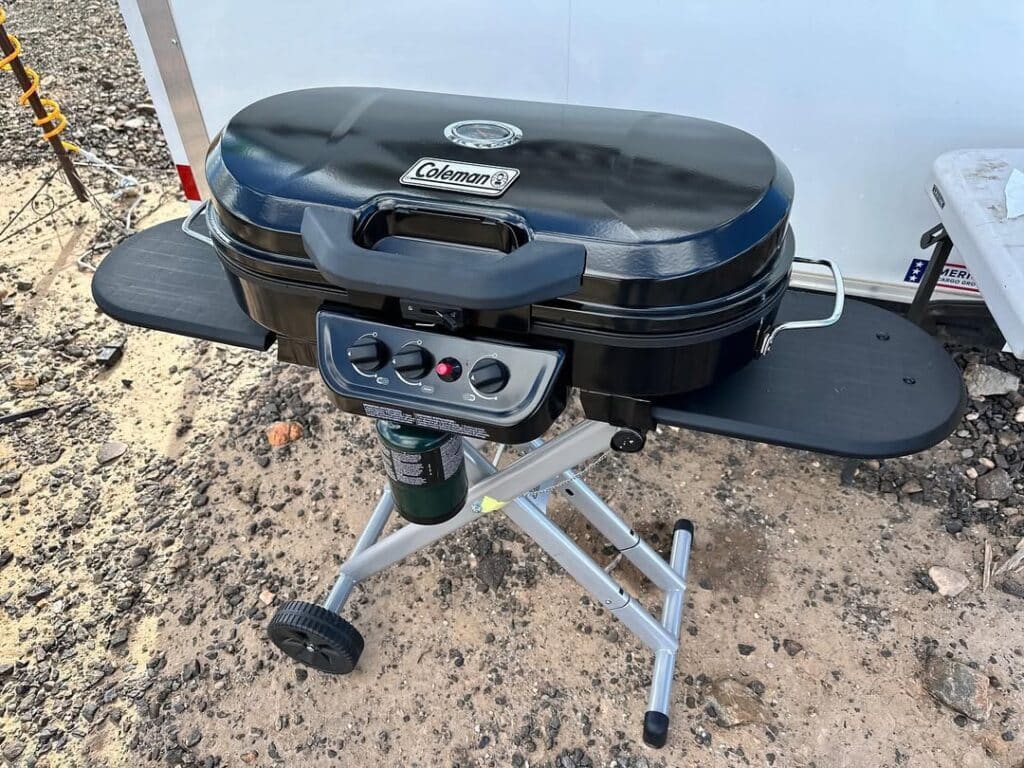
5. Coleman RoadTrip 285: The Classic Updated
You can’t talk about portable gas grills without mentioning Coleman. They’ve been in the camping game since before your grandfather was wearing cargo shorts. The RoadTrip 285 is the modern evolution of their classic “red grill” design.
The “Crowd-Pleaser” Feature: Three independent burners. Yes, you read that right. In a portable unit, Coleman managed to squeeze in three burners, allowing for incredibly precise temperature zones.
Technical Specs:
- Cooking Area: 285 sq. in.
- BTUs: 20,000
- Weight: 46 lbs
- Fuel Type: Propane
The Host’s Verdict: The RoadTrip is the utility player. It comes with swappable cooktops (you can trade the grates for a griddle or a stove grate, sold separately).
It’s the best option for the family that does a bit of everything – tailgating on Saturdays and deep-woods camping on Sundays. It’s reliable, parts are easy to find, and it’s built for the rugged reality of being tossed into the back of a truck.
Deep Dive: The Logistics of Big Group Grilling
Owning a high-capacity portable grill is only half the battle. If you’re planning to feed ten people in a parking lot, you need to think about the “infrastructure” of your cookout.
One of the most common mistakes I see is people relying solely on those little 1lb green propane canisters for a two-hour cookout. Those small bottles are great for a quick dinner for two, but a high-capacity grill with two or three burners will chew through them faster than a teenager through a bag of chips.
Invest in a 20lb tank adapter hose.
It allows you to hook up a standard backyard propane tank to your portable grill. It’s cheaper in the long run, and it ensures you won’t run out of gas right when the thickest steaks hit the grates.
Also, consider your Thermal Recovery Strategy.
When you’re cooking for a crowd, the temptation is to flip the lid open every thirty seconds to see if the hot dogs are done. Every time you do that, you lose the “convection” heat that helps cook the meat through.
On a high-capacity portable, use your zones. Keep the lid down as much as possible, and move cooked items to the “cool” side of the grill to stay warm while the next batch sears.
Maintenance & Longevity for Heavy Use
A high-capacity grill takes more abuse than a standard one simply because it’s doing more work. More meat means more drippings, more carbon buildup, and more potential for flare-ups.
After a big event, don’t just fold the grill and forget it.
Run the burners on high for 10 minutes after the food is off to incinerate any remaining bits. Once it’s cool, give the grates a quick scrape. Because these grills are often moved around, grease management is vital.
Always empty the drip tray before you load the grill into your car. Nothing ruins a post-game high like a gallon of cold grease soaking into your trunk’s upholstery.
Buyer’s Checklist: Final Considerations
To help you decide, here’s the “Quick-Fire” comparison:
- For the Absolute Most Space: Blackstone 22” Griddle (361 sq. in.)
- For the Best Portability/Storage: Weber Traveler (Integrated Cart)
- For Precision Cooking: Napoleon TravelQ PRO285 (Dual Burners)
- For High-Heat Searing: Cuisinart Professional (20,000 BTUs)
- For Versatility: Coleman RoadTrip 285 (Swappable Grates)
Beyond the Specs: Why High-Capacity Grilling Matters
At the end of the day, a great cookout isn’t actually about the BTUs or the square inches – it’s about the fact that everyone ate at the same time and nobody went home hungry.
The right portable gas grills are just the tools that make that magic happen.
Whether you’re flipping smash burgers on a griddle or searing ribeyes on a stainless steel beast, moving to a high-capacity portable rig changes the way you travel. You stop being the person who “brought a snack” and start being the person who “brought the party.”
So, grab your tongs, check your propane levels, and get ready to be the hero of the next tailgate. Which one are you loading up first?
Frequently Asked Questions
How many people can a “high-capacity” portable grill actually feed?
While it depends on what you’re cooking, a grill with 250 to 350 square inches of space can typically handle 10 to 15 standard burger patties at once.
In a real-world scenario, this allows you to feed a group of 8 to 12 people in a single “round” of grilling without making guests wait for a second batch.
Can I use a standard 20lb propane tank with these grills?
Yes, but you will almost certainly need an adapter hose. Most portable gas grills are designed out of the box to use 1lb disposable propane cylinders.
By purchasing a 4-foot or 6-foot adapter hose, you can connect to a standard backyard tank, which is much more cost-effective for long tailgates or camping trips.
Do portable grills get hot enough to sear a steak?
Absolutely, though some are better at it than others. Look for a grill with at least 10,000 to 12,000 BTUs.
High-capacity models like the Cuisinart Professional or the Napoleon TravelQ are specifically designed to reach the high temperatures (500°F+) necessary to achieve a professional-grade crust on thick cuts of meat.
Is a dual-burner system really necessary for portability?
If you are only cooking hot dogs, a single burner is fine. However, for a large cookout, a dual-burner system is a game-changer.
It allows for “two-zone cooking,” where you can have high heat on one side for searing and low heat on the other for toasted buns or keeping finished food warm.
Without it, you run a high risk of burning the outside of your food before the inside is cooked.
How do I clean a portable grill while traveling?
The best method is the “Burn-Off.” Once you’re done cooking, turn the burners to high for about 10 minutes to carbonize any grease.
Give it a quick scrape with a grill brush, let it cool completely, and ensure the drip tray is emptied before putting it back in your vehicle.
For griddles like the Blackstone, a quick scrape and a light coat of oil while the surface is still warm will keep it seasoned and rust-free.
Are these grills too heavy for one person to carry?
Most high-capacity portables weigh between 30 and 50 pounds.
While models like the Weber Traveler have wheels and a handle that make them easy for one person to maneuver, tabletop versions might require a bit more muscle.
If portability is your main concern, look for models with integrated carts or locking lids that make them feel more like a suitcase than a piece of machinery.
Featured image credit: @completehomeconcepts
