
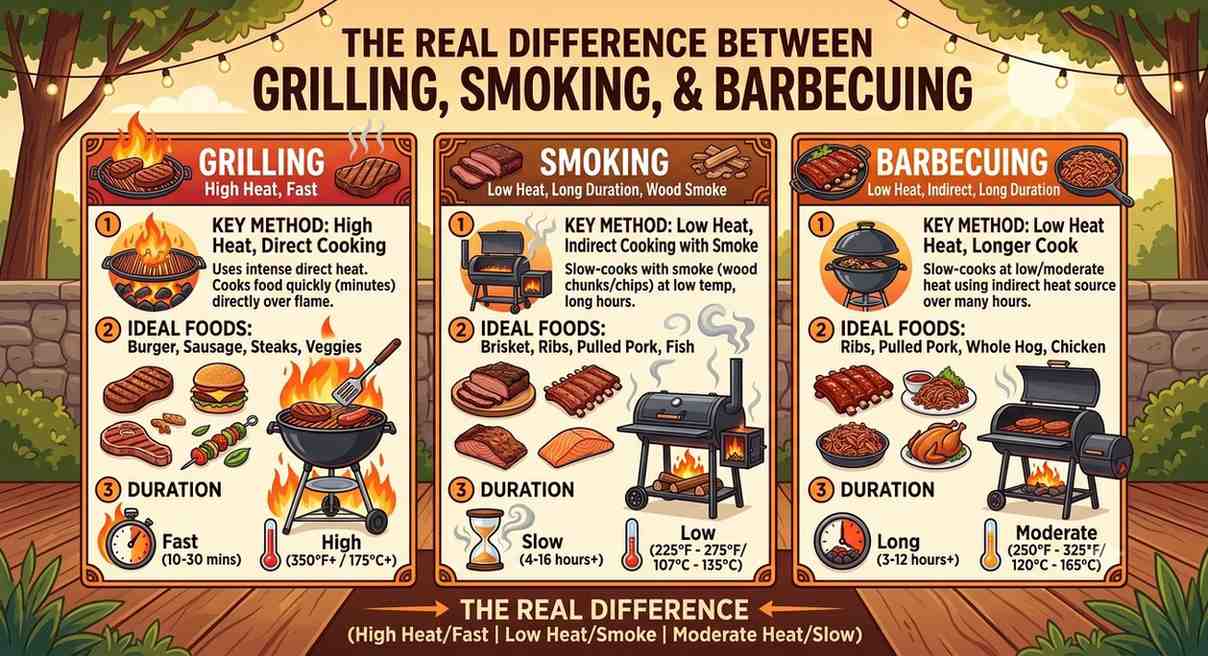
Language drifts over time, but invite a neighborhood over for a “barbecue” and then serve them hot dogs cooked in ten minutes over propane, and a Texan might just pass out right into your flower bed.
The English language uses the words grilling, smoking, and barbecuing interchangeably, blurring the lines of outdoor cooking. In reality, these three methods live in completely different zip codes.
They use different physics, different cuts of meat, and entirely different mindsets.
Misunderstanding these concepts is the quickest way to ruin an expensive piece of meat. Tossing a tough beef brisket onto a fiery grate destroys it, just as leaving a delicate filet mignon over indirect smoldering hickory for eight hours results in leather.
The real difference comes down to a simple trinity: time, temperature, and the direction of heat. Master this trio, and you control the flavor universe.
The Science of Outdoor Cooking
Fire is fire, but how that energy hits your dinner changes everything. Outdoor cooking relies on two main types of heat transfer: direct radiant heat and indirect convective heat.
For direct radiant heat (grilling), the meat sits directly above the heat source, and the intense energy hits the surface of the food from below. This process cooks the outside fast, making it ideal for thin items.
For indirect convective heat (barbecuing and smoking), the meat is moved away from the flame and the lid is closed, causing the cooker to act like a home oven. Hot air and smoke circulate around the food, cooking it evenly from all sides.
Airflow acts as the steering wheel of your cooker. Fast-moving air dries out the surface of the meat, which helps develop a crust but can sap internal moisture.
Slow, controlled airflow keeps the environment humid, allowing tough tissues to break down without drying to a crisp. Heat alters different parts of the meat at different rates:
- Proteins contract and squeeze out water as temperatures rise.
- Fats melt and lubricate the muscle fibers.
- Connective tissue melts into rich gelatin, but only under specific time and temperature rules.
Pillar 1: Grilling – High Heat, Blazing Speed
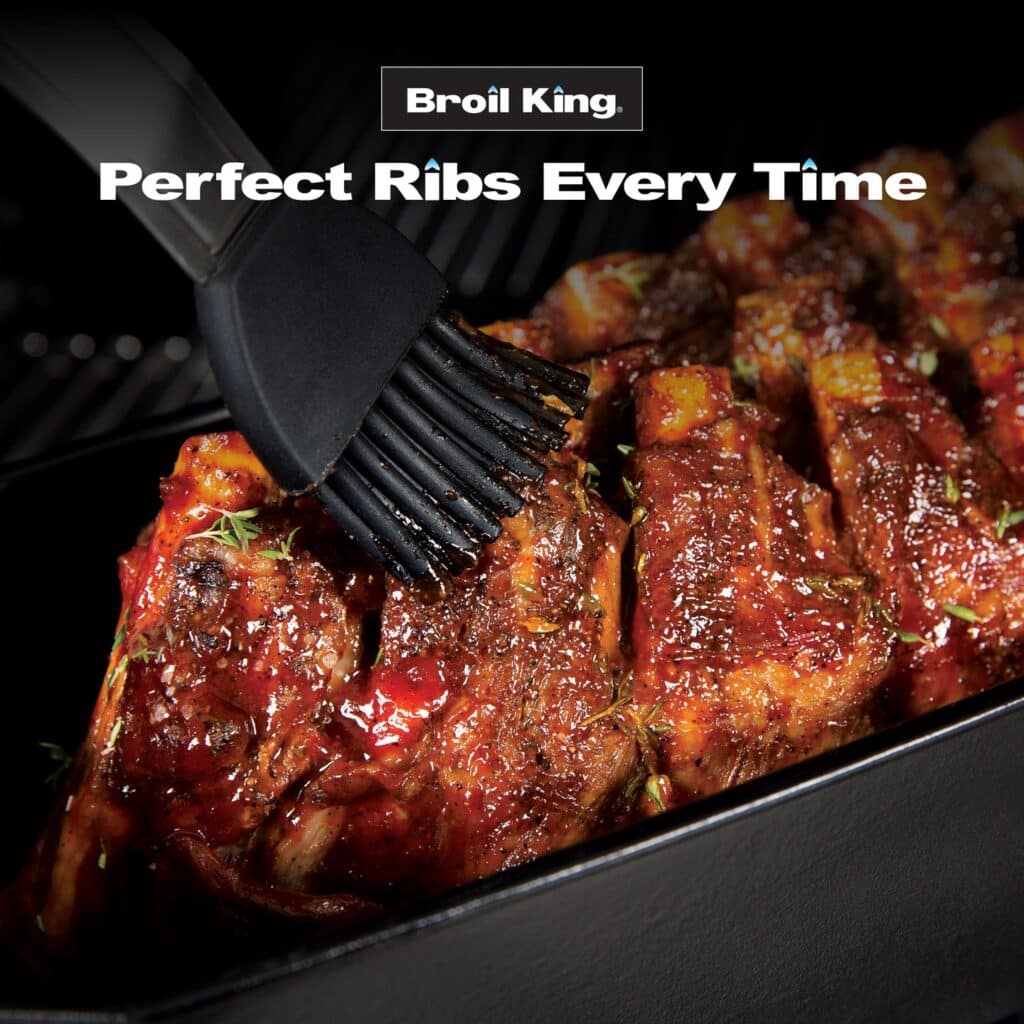
Grilling is the sprint of the outdoor cooking world. It uses extreme heat and demands constant attention. Walk away to grab a drink, and your dinner transitions from beautifully seared to a cinder.
The Core Parameters of the Sprint
- Temperature range: 400ºF to 700ºF+ (204ºC to 371ºC+)
- Timeframe: Measured in minutes.
The magic of grilling relies on the Maillard reaction.
This chemical reaction occurs between amino acids and reducing sugars when exposed to high heat. It creates hundreds of new flavor compounds, giving seared steak, charred burgers, and roasted coffee their irresistible aromas.
Without high heat, your meat looks gray, boiled, and unappetizing. High direct heat leads directly to the Maillard reaction, which forms that deep flavor crust.
Direct vs. Indirect Setups
Many backyard cooks make the mistake of running their grill at maximum capacity across the entire surface. Managing the heat requires a two-zone fire setup.
- The Hot Zone: Place your charcoal or turn your gas burners to high on one side of the grill. Use this area for direct radiant heat to sear the outside of your food.
- The Cool Zone: Keep the other side of the grill free of coals or turn the burners off. This area uses indirect heat, allowing thick steaks or bone-in chicken to finish cooking through the middle without burning the outside.
Best Foods for the Grate
Grilling suits tender, naturally marbled, or lean cuts that do not need time to soften up. Good choices include skirt steaks, ribeyes, burgers, pork chops, chicken breasts, shrimp, and asparagus.
For equipment, charcoal kettles offer high heat and a classic smoky accent.
Gas grills provide convenience and precise temperature adjustments at the turn of a dial. Infrared burners act like commercial steakhouse broilers, generating intense radiant heat that creates a restaurant-quality crust in seconds.
Pillar 2: Barbecuing – The Low and Slow Art
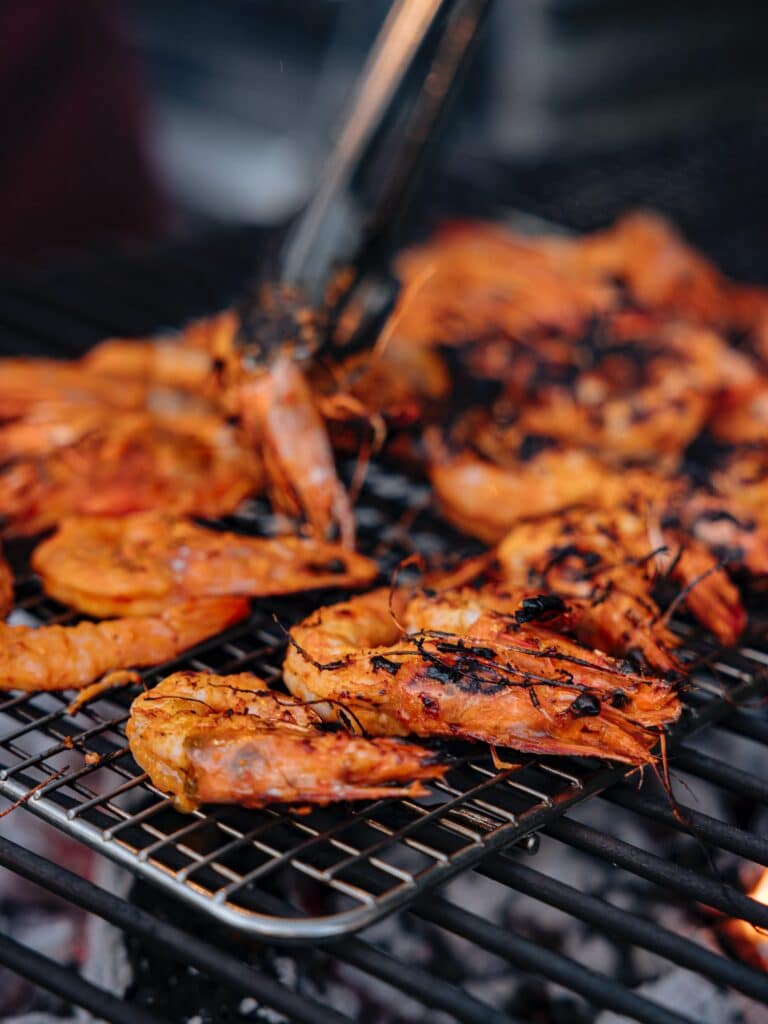
Barbecuing abandons the frantic pace of grilling for a slow, patient approach. True barbecue requires low temperatures and long hours to transform tough cuts into tender meals. Under low indirect heat combined with time, tough collagen melts down into tender meat.
The Core Parameters of the Marathon
- Temperature range: 225ºF to $275ºF (107ºC to $135ºC)
- Timeframe: Anywhere from 4 to 16+ hours.
High-heat grilling ruins tough cuts like beef brisket or pork shoulder, turning them into rubber. These pieces of meat are packed with collagen and connective tissue, the structural proteins that hold hard-working muscles together.
Collagen acts like iron cables. At high temperatures, those cables snap tight and squeeze out every drop of moisture. But cook that meat low and slow, and the collagen breaks down, melting into rich gelatin.
This gelatin coats the muscle fibers, giving the meat a juicy, melt-in-your-mouth texture.
The Cultural Map of Barbecue
True barbecue is deeply rooted in regional styles across the United States, each defined by its choice of meat, wood, and sauce:
- Central Texas: Focuses on beef brisket rubbed simply with salt and black pepper, cooked over post oak wood with no sauce allowed.
- The Carolinas: Centers on pork, usually pulled pork shoulder or whole hog, mopped with a sharp, thin vinegar or mustard-based sauce.
- Memphis: Famous for pork ribs, served either “wet” with a sweet tomato sauce or “dry” coated in a thick layer of savory spices.
- Kansas City: The ultimate melting pot, barbecuing everything from beef to burnt ends, covered in a thick, sweet, molasses-heavy sauce.
The Ideal Roster
Barbecuing requires cuts with plenty of fat and connective tissue. Look for beef brisket, pork butt, pork ribs, and beef plate ribs.
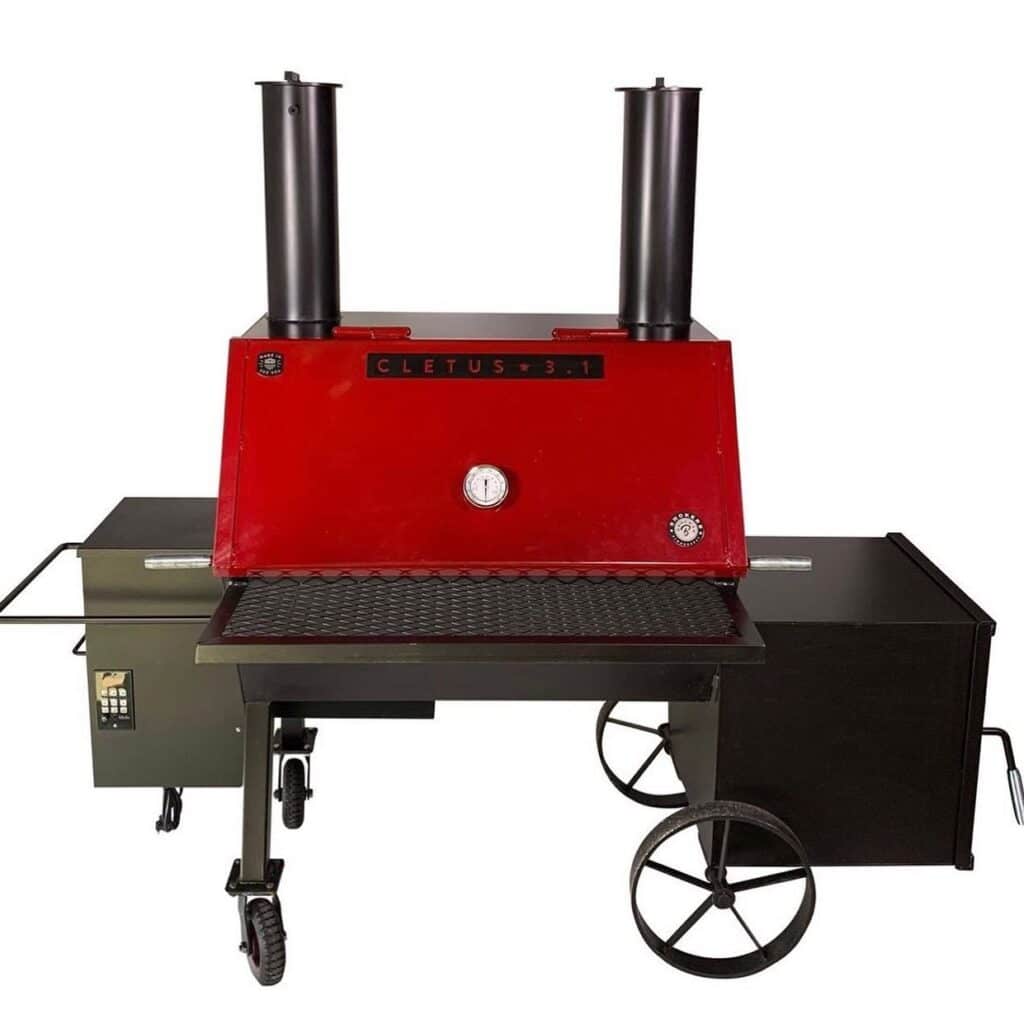
Cooking these cuts requires specialized gear. Offset smokers burn logs in a separate firebox, pulling heat and smoke across the meat. Pellet grills use automated wood pellets for set-it-and-forget-it convenience.
Ceramic Kamados feature thick, insulated walls that hold steady temperatures for hours on a single handful of charcoal.
Pillar 3: Smoking – Flavoring with the Element of Wood
Smoking overlaps with barbecuing, but they are not identical. Barbecuing uses smoke to flavor meat while it cooks. Smoking focuses purely on using wood smoke as a flavor profile, a preservation method, or an ingredient.
You can smoke foods without really cooking them at all. The process split into two main pathways: hot smoking, which cooks and flavors between 125ºF and 175ºF (52ºC to 79ºC), and cold smoking, which cures and preserves between 70ºF and 90ºF (21ºC to 32ºC).
The Two Pathways: Hot vs. Cold
Smoking splits into two distinct techniques based on temperature goals:
- Hot Smoking: This process flavors and cooks food at the same time. It is warmer than cold smoking but cooler than barbecue, making it ideal for delicate proteins that dry out easily.
- Cold Smoking: This method infuses smoke flavor without cooking the food. The food sits in a chamber completely separated from the heat source. This technique cures, preserves, and flavors foods that would melt or spoil under actual heat.
The Chemistry of the Smoke Ring
Smoke is a complex mix of gases, water vapor, and tiny wood particles. When wood burns, it breaks down lignin and cellulose, the organic polymers that give trees their structure.
This breakdown releases compounds like phenols and guaiacols, which provide the classic smoky aroma and woody flavor.
This process creates the smoke ring, a bright pink band just beneath the dark surface of barbecued meat. The ring develops when nitric oxide gas from the wood fire dissolves into the moist surface of the meat.
It binds with myoglobin, the iron-rich protein that gives raw meat its red color. This chemical bond prevents the myoglobin from turning brown during the cook, leaving a permanent pink ring that shows the meat was cooked over real wood.
Selecting Wood Profiles
Wood functions as an ingredient, and matching the right wood to your food is key:
- Mesquite: Strong and intense. It burns hot and can turn bitter if overdone, making it best for quick charcoal grilling or short beef cooks.
- Hickory: The classic barbecue wood. It delivers a bold, bacon-like flavor that works well with pork and beef.
- Pecan: A milder cousin of hickory. It offers a sweet flavor that pairs well with poultry and pork.
- Apple and Cherry: Mild, fruity, and sweet. These woods give poultry and pork a beautiful, deep mahogany color.
The Smoking Menu
Hot smoking works well for salmon, trout, whole turkeys, and duck breasts. Cold smoking fits delicate foods like hard cheeses, bacon, lox, hard-boiled eggs, and nuts.
Head-to-Head Comparison Matrix
| Feature | Grilling | Barbecuing | Smoking |
| Heat Type | Direct Radiant Heat | Indirect Convective Heat | Pure Indirect Convective |
| Temperature | 400ºF – 700ºF+ (204ºC – 371ºC) | 225ºF – 275ºF (107ºC – 135ºC) | 70ºF – 175ºF (21ºC – 79ºC) |
| Cook Time | 5 to 30 minutes | 4 to 16+ hours | 2 to 48 hours |
| Primary Goal | High-heat sear & crust | Render fat & melt collagen | Infuse deep wood wood flavor |
| Ideal Fuel | Gas, Lump Charcoal, Infrared | Hardwood Logs, Charcoal, Pellets | Sawdust, Wood Chunks, Pellets |
| Best Target | Steaks, Burgers, Veggies | Brisket, Pork Butt, Ribs | Salmon, Cheese, Bacon, Jerky |
Choosing Your Method: The Ultimate Decision Matrix
Choosing a cooking method comes down to assessing your time, your ingredients, and your flavor goals.
The Time Assessment
If dinner needs to be on the table in under an hour, stick to the grill. Attempting to rush a barbecue cut by cranking up the heat results in a tough, unchewable meal.
If you have a free Saturday and want to spend the day managing a fire, fire up the smoker or barbecue pit.
The Meat Assessment
Look closely at the cut of meat before cooking:
- Lean and Tender: If it has little fat and no tough connective tissue (like a tenderloin, ribeye, or chicken breast), grill it hot and fast.
- Tough and Fatty: If it comes from a hard-working muscle group loaded with fat and collagen (like a shoulder, neck, or brisket), cook it low and slow.
The Flavor Goal
When you want a crisp char and the taste of seared fats, choose the grill. When you want tender meat with a balance of wood smoke, spice rub, and rendered fat, choose barbecue.
If you want to highlight the clean, distinct aroma of wood smoke on a delicate protein or dairy product, stick to smoking.
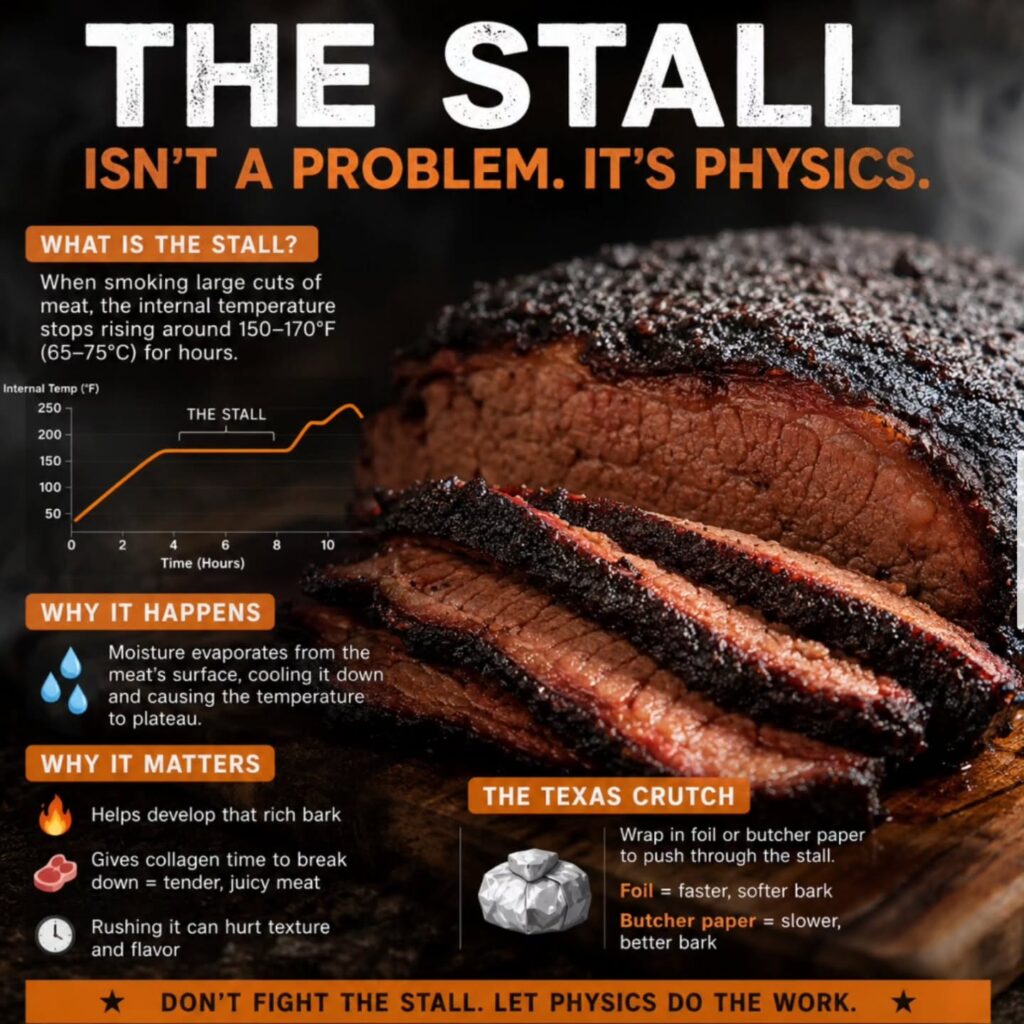
The Physics of Stall: Why Your Barbecue Stops Cooking
Every pitmaster eventually hits the stall, a maddening phase where a brisket’s internal temperature gets stuck around 160ºF (71ºC) and refuses to budge for hours. While it feels like your cooker died, it is actually a basic physics lesson in action:
- Evaporative Cooling: As heat forces moisture to the surface of the meat, that liquid evaporates. This surface evaporation cools the meat at the exact same rate the pit is trying to heat it.
- The Texas Crutch: To beat this thermal gridlock, professionals tightly wrap the meat in peach butcher paper or aluminum foil.
- The Result: Wrapping traps the moisture, stops the surface evaporation completely, and forces the internal temperature to climb again – saving both your timeline and your sanity.
Ash and Ember Management: The Clean Fire Secret
Great barbecue does not come from thick, billowing white clouds; it comes from a faint, nearly invisible emission known as thin blue smoke. Achieving this flavor sweet spot requires masterful ash and ember management:
- The Danger of White Smoke: Heavy white smoke is packed with unburnt soot and bitter creosote. This leaves a harsh, acrid film on your food that tastes like an ashtray.
- Coal Bed Maintenance: To avoid creosote, you must maintain a small, intensely hot coal bed rather than choking your firebox with massive, uncharred logs.
- Airflow Control: Precise intake damper adjustments ensure oxygen feeds the flames efficiently, creating a clean, sweet burn instead of a smothering smudge.
Carryover Cooking: The Secret Phase After the Heat
The cook does not end when you pull your meat off the steel grates. Carryover cooking is a hidden thermodynamic phenomenon that can easily ruin a perfect meal if ignored:
- The Temperature Jump: Internal temperatures continue to rise by 5ºF to 15ºF (3ºC to 8ºC) after you remove the food from the heat source.
- The Energy Shift: Because the outer layers hold a much higher thermal mass than the center, that kinetic heat energy naturally continues moving inward.
- Predictive Pulling: To prevent dry, overcooked proteins, you must pull a thick ribeye early at 130ºF (54ºC) so it peaks perfectly at a juicy, medium-rare 135ºF (57ºC) on the cutting board.
Thermal Conductivity: Why Your Grate Material Matters
When you drop a burger onto a hot surface, the speed of heat transfer dictates your crust. This comes down entirely to the thermal conductivity of your cooking grates:
- Cast Iron Grates: These act like heavy thermal batteries. They hold a massive amount of heat energy and transfer it rapidly via direct conduction, creating deep, defined sear marks.
- Stainless Steel Grates: These transfer heat at a slower rate, but they offer much easier maintenance and deliver a more uniform surface cook across the entire protein.
- The Takeaway: Choosing the right metal armor for your culinary goals allows you to optimize surface contact and maximize the flavor-packed Maillard reaction every single time.
Fire, Time, and Flavor: The Backyard Holy Trinity
No single style of outdoor cooking reigns supreme. Grilling, smoking, and barbecuing are simply different tools inside the same culinary toolbox.
A true master of the flame knows exactly when to sprint with a searing grate, when to run the distance with a low-and-slow barbecue pit, and when to let wood smoke gently flavor a delicate piece of fish.
Stop treating every outdoor cookout like a standard burger flip. Take a look at your ingredients, check your clock, pick the right technique, and control your fire. Your backyard guests will thank you.
Frequently Asked Questions
Is it still considered barbecuing if I use a gas grill?
Technically, no. If you are throwing burgers or chicken breasts over open gas burners for 15 minutes, you are grilling. True barbecuing requires indirect, low heat (225ºF to 275ºF) and wood smoke over a long period.
However, you can turn a gas grill into a temporary barbecue pit by turning off half the burners (creating an indirect zone) and using a foil pouch filled with wood chips to generate smoke.
Can you smoke meat without barbecuing it?
Absolutely. While barbecuing always involves smoke, smoking can be an entirely separate process called cold smoking. When you cold smoke items like cheese, lox, or bacon, you keep the temperature below 90ºF (32ºC).
The goal is to cure and flavor the food with wood smoke without actually cooking the protein at all.
What is the single biggest mistake people make when transitioning from grilling to BBQ?
Rushing the process. Grilling rewards speed and high heat, but barbecue demands patience.
If you get impatient with a tough cut like pork shoulder or brisket and crank up the cooker temperature to “speed things up,” you will seize the muscle fibers, dry out the natural juices, and end up with an unchewable piece of meat.
You cannot rush the time it takes for collagen to melt.
How do I know if my fire is producing “clean” smoke or “dirty” smoke?
Look at the color and behavior of the smoke leaving your exhaust damper:
- Dirty Smoke: Thick, billowing, puffy, and stark white or gray. It smells acrid and bitter because the wood is smoldering without enough oxygen.
- Clean Smoke: Thin, wispy, and nearly invisible with a faint tint of blue (known as thin blue smoke). It smells sweet, rich, and pleasant, indicating a perfectly burning fire.
Does wrapping meat in foil during the stall ruin the bark?
It can soften it slightly, but it won’t ruin it if done correctly.
Standard aluminum foil traps 100% of the moisture, which can make the crunchy exterior (the bark) a bit mushy. To protect that crust while still beating the stall, many pitmasters use peach butcher paper instead.
It is porous enough to let excess steam escape so your bark stays intact, but insulated enough to keep the cook moving forward.
Featured image credit: Google Gemini
